Roscommon anchors the county of the same name almost exactly at the geographic heart of Michigan's northern Lower Peninsula, a former logging settlement whose Irish place name and modest year-round population belie its long-running role as a gateway to some of the region's most popular lake and forest recreation. The town's own economic arc, from sawmill camp to seasonal cottage hub, tracks the broader transformation that reshaped nearly every community across Michigan's timber country over the past century and a half.
From Mikenauk to Roscommon
Roscommon County was originally organized under the name Mikenauk County in 1840 before being renamed in 1843 for County Roscommon in Ireland, and the town of Roscommon that grew up within it inherited the county's borrowed Irish name when George Robinson of Detroit became one of its earliest settlers around 1845. The community's development proceeded at a genuinely modest pace for its first few decades, gaining its own post office only in 1873 under first postmaster Alfred Bennett, before being designated the county seat in 1875 and formally incorporating as a village in 1882.
By 1873, Roscommon had secured a station on the Michigan Central Railroad, a connection that proved essential to the logging economy that dominated the town's earliest commercial life, with sawmills and shingle mills processing the tall white and red pines that once covered the surrounding county before the lumber era stripped most of that original forest away.
Logging Town to Cottage Country
Roscommon's identity as a working sawmill town persisted through the 1870s, 1880s, and 1890s, its economy tied directly to the same timber boom reshaping northern Michigan more broadly, but as the accessible old-growth pine ran out around the turn of the twentieth century, the town's fortunes gradually shifted toward an entirely different industry. By the 1930s, Roscommon's economy had pivoted decisively toward lakeside tourism and recreation, a transition helped along by the county's abundance of lakes, including nearby Houghton Lake and Higgins Lake, both of which drew a growing stream of seasonal cottage owners and vacationing families as the automobile made northern Michigan increasingly accessible to downstate visitors.
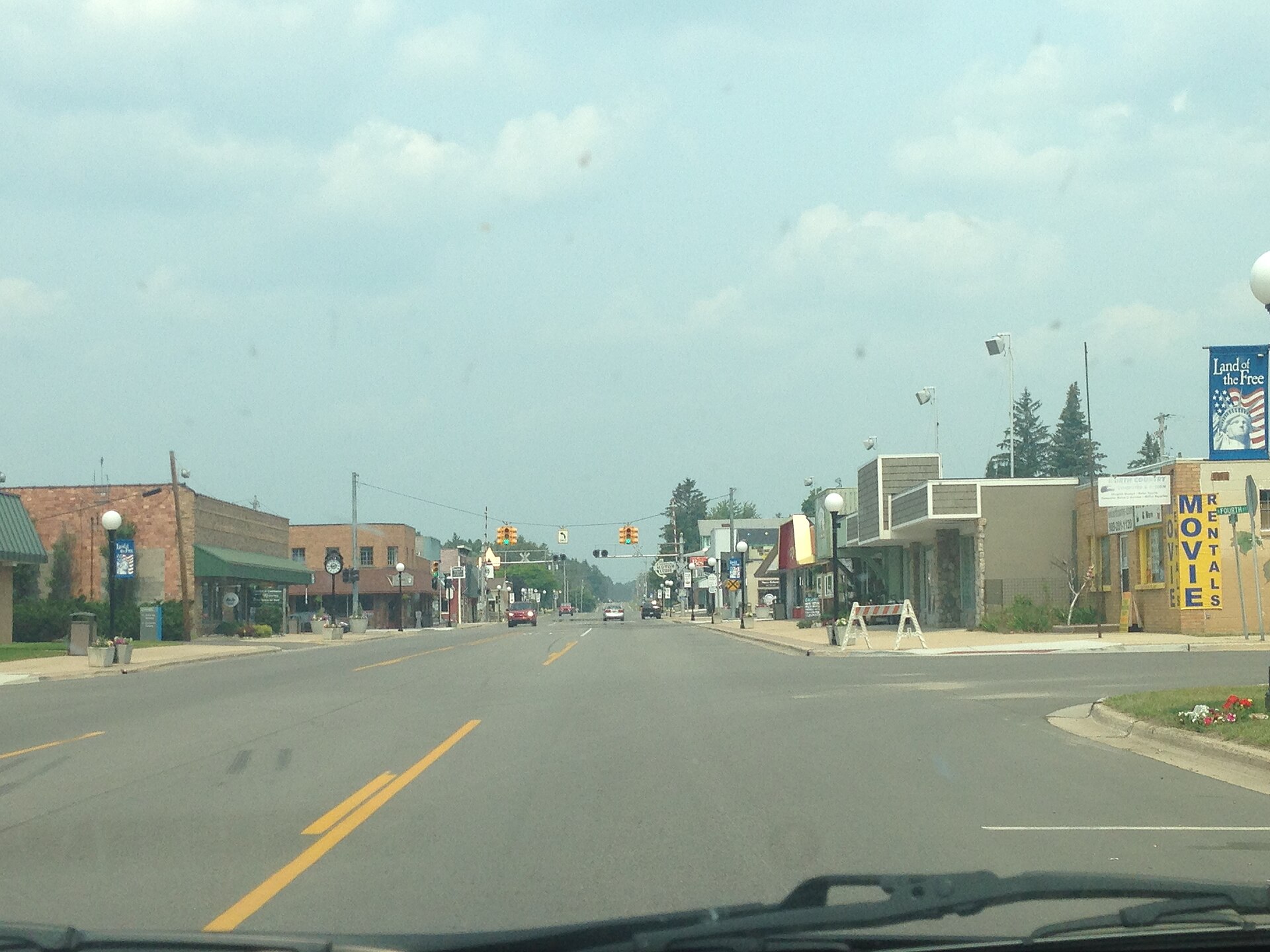
That recreational identity has only deepened in the decades since, with Roscommon's small downtown today functioning primarily as a supply and service hub for the surrounding lake communities rather than as a destination unto itself, a quietly practical role that nonetheless keeps the town relevant to the thousands of seasonal visitors who pass through it every summer on their way to the water.