In This Guide
The Ledges: Rock From an Ancient Shoreline Rock Climbing at Oak Park Seven Islands Resort and the Golden Age Festivals and Downtown Grand Ledge Planning Your Grand Ledge VisitMid-Michigan is rarely associated with cliffs, which is exactly why Grand Ledge comes as such a pleasant surprise. A dozen or so miles west of downtown Lansing, the Grand River slices through banks of layered sandstone that rise about forty feet above the water, forming the dramatic ledges that give the city its name. Native people who lived along the river called them by a name translated as Big Rocks, and nineteenth-century entrepreneurs turned the riverbanks into one of Michigan's most popular resorts. Today the city of nearly eight thousand residents blends a walkable historic downtown with riverside parks, hiking trails, and one of the few places in Michigan for outdoor rock climbing. The City of Grand Ledge maintains parks along both banks of the river, linked by footbridges and a riverwalk. This guide covers the ledges, the history, and the events that make Grand Ledge worth a day or a weekend.
The Ledges: Rock From an Ancient Shoreline
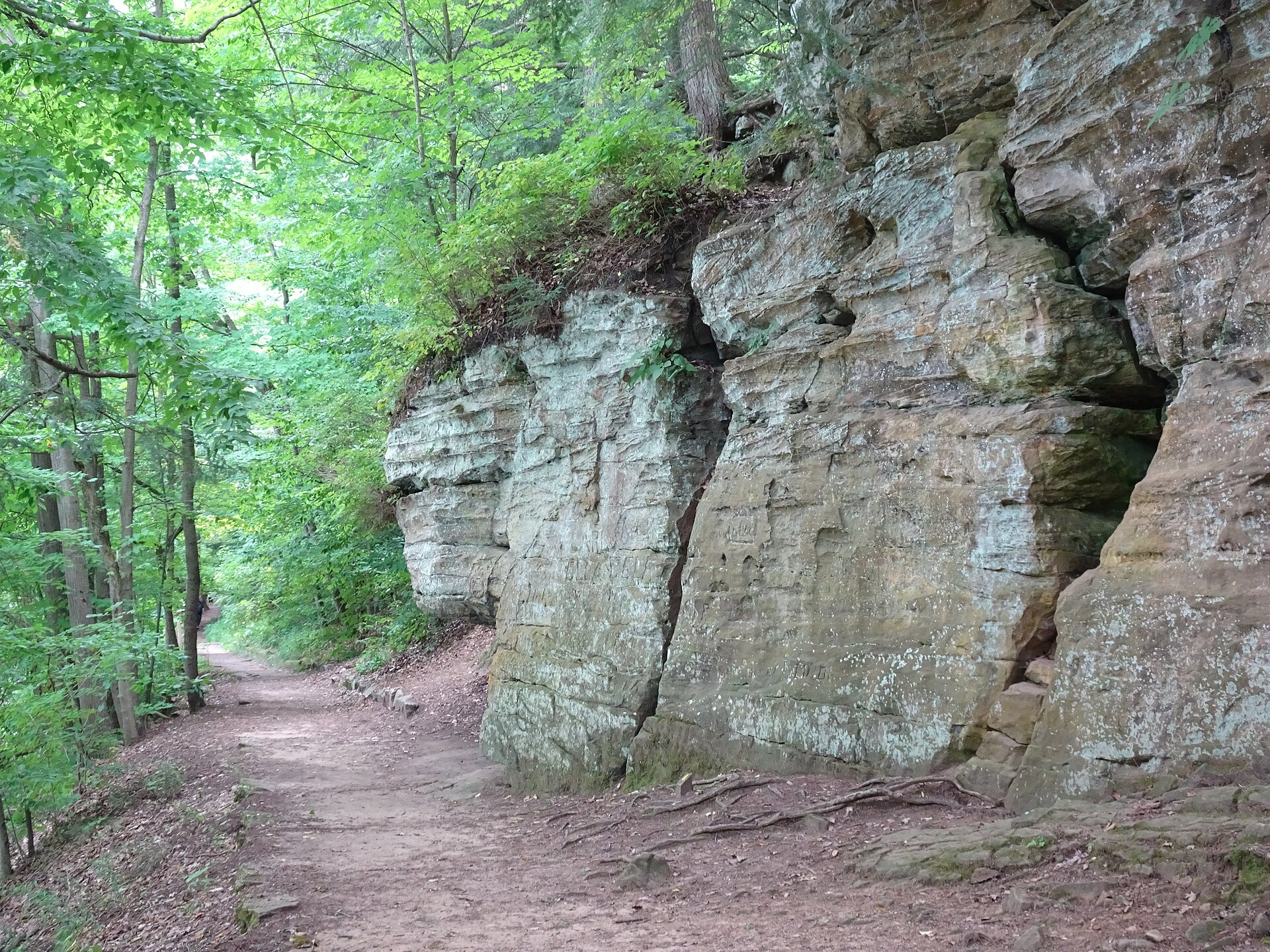
The ledges are far older than the river that exposes them. They are Pennsylvanian-age sandstone and shale, laid down roughly three hundred million years ago in a near-shore setting where marine and land deposits alternated, as explained in a Grand Valley State University geology tour of Grand Ledge. A 1987 Geological Society of America field guide called them the best exposure of Pennsylvanian rocks in Michigan, and the Saginaw Formation that forms much of the outcrop is formally tied to Grand Ledge in the USGS geologic names lexicon. The rock holds fossilized plants, invertebrates, and trace fossils left by ancient fish. Native people once dug coal from seams along the riverbanks, and shale from local quarries was later used to manufacture drainage tile and sewer pipe. Look closely at the cliff faces and you can see bands of sandstone and shale that record a long-vanished coastline. Standing at the base of the ledges, you are looking at a page torn from the deep history of the continent.
The best place to see the ledges up close is Eaton County's Fitzgerald Park, where about three miles of trails wind near the river, and the Fitzgerald County Park listing on Michigan Trail Maps provides a trail overview. The Ledges Trail follows the base of the cliffs along the water, passing beneath overhangs of layered stone and linking Fitzgerald with downtown's Island Park. The ledges at Fitzgerald are protected for observation only, so climbing is prohibited there, and signs ask visitors not to carve or write on the soft stone, which accelerates erosion. That erosion is real: in 2023, a section of ledge broke away, prompting concern about the formations' long-term stability, as WILX reported. A modest vehicle entry fee has applied at the county park, though visitors can also park downtown and walk the riverwalk. The trail can be muddy and uneven after rain, so wear sturdy shoes.
Rock Climbing at Oak Park
Across the river, the city-owned Oak Park is one of the few places in Michigan where climbers can rope up on natural rock. The sandstone wall stands about forty feet tall and offers bouldery, challenging climbs, with nearly a hundred routes ranging from beginner-friendly lines to very difficult test pieces, and top ropes are typically anchored around the large trees along the cliff top, according to the community-maintained Mountain Project guide to Grand Ledge. The area was first climbed in the late 1940s, and in the 1970s a group of local climbers nicknamed the Grand Ledge Rats established many of the lines still considered classics. The climbing community has accepted restrictions to keep access open, including no climbing beyond posted signs at the west end and above a feature known as the Ballerina Bulge, where brittle rock can fall, as the Mountain Project top-rope section explains. Rock quality varies, with solid classics alongside loose sections, so beginners should climb with experienced partners. Respect the rules and the resource, because continued access depends on climbers' good behavior.
Even non-climbers enjoy watching from the riverbank, where the vertical cliffs and the slow green river create a scene that feels transplanted from somewhere far more rugged. Evenings and weekends with good weather draw the biggest crowds of climbers, which makes them the liveliest times to watch. The Grand River, Michigan's longest river at about 252 miles, flows on from here toward Portland, Ionia, and eventually Lake Michigan at Grand Haven. Paddlers can view the ledges from the water, and the river's history as a transportation corridor is a reminder that this landscape has drawn people for generations. A 1987 field trip guide from the Michigan Geological Survey archive describes the outcrops on both banks in detail for anyone curious about the science. From the water or the trail, the ledges reveal their height and texture in a way few Lower Peninsula landscapes can match.
Seven Islands Resort and the Golden Age
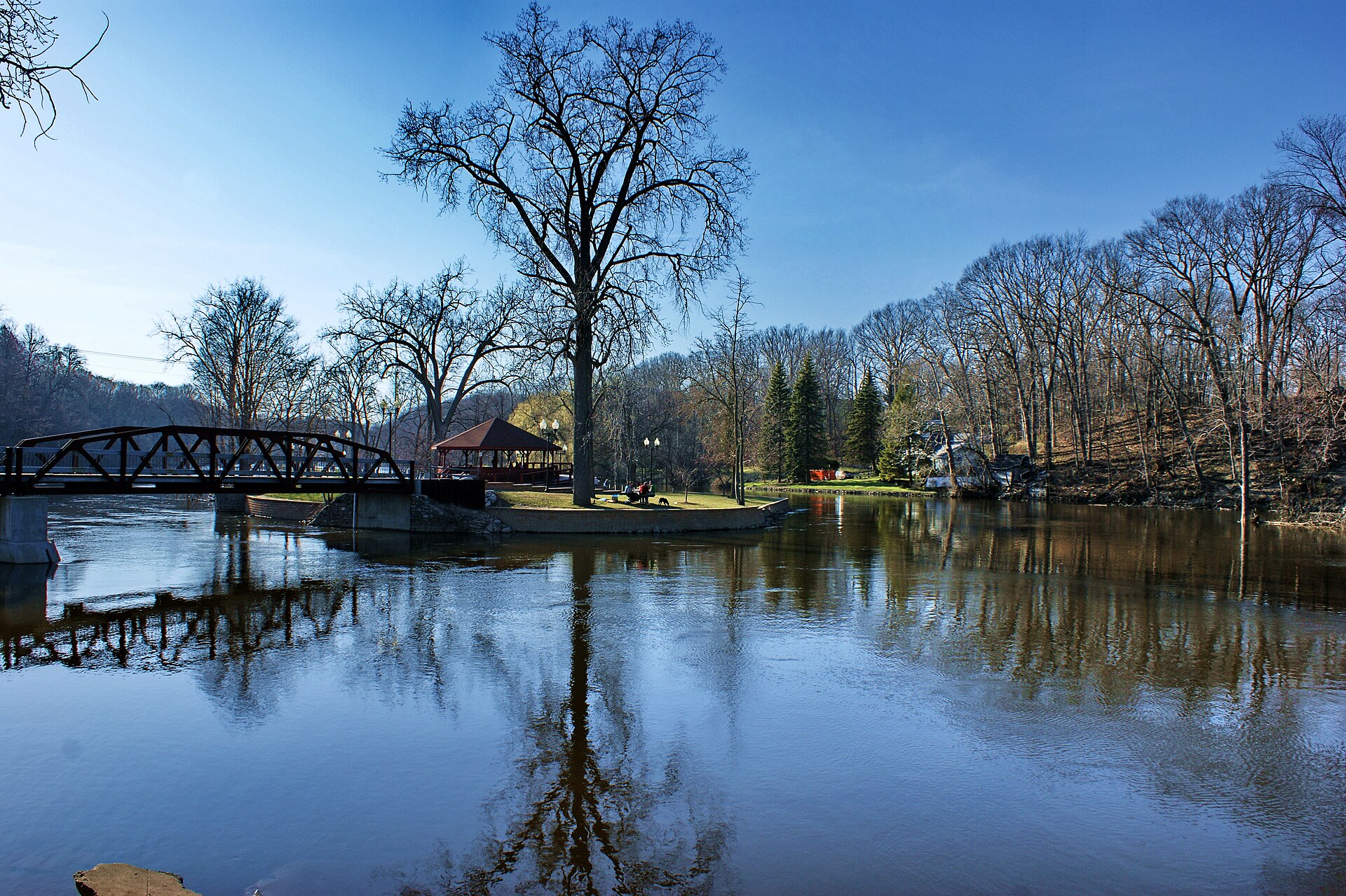
In the 1870s, the arrival of the railroad turned Grand Ledge into a resort town. John Burtch founded the Seven Islands Resort in 1872, with a small steamer and an inn on Second Island, and mineral wells drilled on the islands were promoted for their supposed curative powers, as Wikipedia's account of the resort era recounts. Under later owner Julian Scott Mudge, the resort grew into a regional sensation, with a hotel, a pavilion for dances and vaudeville acts, an animal park, a merry-go-round, and, in 1891, a roller coaster thought to be among the first in Michigan. By the late 1880s an estimated sixty to seventy thousand visitors arrived each year, many on excursion trains, and as many as nine hotels served them. Mudge's most famous project was the Round House, a three-story pagoda designed so its upper floors would rotate, topped by a swing that would whirl riders out over the river. A spring flood in 1893 shoved ice into its foundation, and the rotating machinery was never repaired, earning the building the nickname Mudge's Folly; an Archives of Michigan photograph collection describes the decorative pagoda as an icon of the area. Little of the resort survives, but the islands remain public parkland, and the story lends a whimsical layer to every stroll along the river.
Grand Ledge's cultural life is anchored by the Grand Ledge Opera House, which began as the Riverside Rink, a roller-skating hall that opened in 1884, before being transformed into Sackett's Opera House in 1886. Over the following decades it hosted vaudeville, silent films, talent shows, and athletic contests, served as a furniture store from 1928, and was donated to the historical society by the Mapes family in 1984. Today it houses an antique Barton theatre organ originally installed in Lansing's Michigan Theatre, and the hall hosts weddings, receptions, and community events. A few blocks away, the Grand Ledge Area Historical Society Museum occupies an 1880 Gothic Revival house built by minister Byron S. Pratt and presents a new exhibit theme each year. The society also offers a self-guided walking tour of the historic downtown and neighborhoods. Together they make Grand Ledge a rewarding stop for anyone curious about small-town Michigan history.
Festivals and Downtown Grand Ledge
Downtown Grand Ledge, centered on Bridge Street near the river, is compact, walkable, and lined with locally owned shops, restaurants, and cafés. Each June brings Yankee Doodle Days, a free celebration with a morning market, a parade along Bridge Street, children's activities, and evening fireworks, as previewed by Lansing City Pulse. In early August, the long-running Island Art Fair draws artists from across the Midwest; in 2026 it moved to the larger grounds of Fitzgerald Park and grew to more than two hundred exhibitors, as WILX reported. Autumn brings a fall festival spread across several riverside parks, successor to the long-running Color Cruise and Island Festival. The parks connect via footbridges, so festival-goers can wander from one bank to the other. Check the chamber's calendar for exact dates, since they shift from year to year.
Grand Ledge also makes an excellent base for exploring the Lansing region. The state capital, with its museums and the Michigan State Capitol, is about twenty minutes east, while Michigan State University's campus in East Lansing offers gardens, museums, and Big Ten sporting events. The Lansing River Trail provides miles of paved riverside paths for walking and cycling. Downstream along the Grand River, the historic town of Portland offers more riverside parks and a picturesque downtown. Many visitors combine a morning at the ledges with an afternoon in Lansing. Families appreciate that the whole area can be explored without long drives.
Planning Your Grand Ledge Visit
Grand Ledge is an easy day trip from anywhere in mid-Michigan, reached via M-43 from Lansing or M-100 from Interstate 96 and Interstate 69. Parking is available downtown and at the riverside parks, and most attractions sit within walking distance of one another. The Grand Ledge Area Chamber of Commerce maintains business listings and event information, while Eaton County's Fitzgerald Park page lists hours, amenities, and the park's history, from an 1894 spiritualist camp to a public park named for Governor Frank D. Fitzgerald. Spring and fall are especially beautiful seasons, when the river runs high or the hardwoods along the ledges turn gold and red. Summer brings the busiest festival calendar, and in winter, icicles can form along the rock faces. Whatever the season, wear sturdy shoes, since trails near the river can be slick.
A perfect day might begin with coffee downtown, followed by a walk along the Ledges Trail, lunch on Bridge Street, an afternoon watching climbers at Oak Park, and a sunset stroll across the footbridges of Island Park. History buffs can add the Opera House and the historical museum, while families might pack a picnic for the riverside lawns. Theater lovers should note that the historic Ledges Playhouse, a converted barn in Fitzgerald Park that has hosted summer theater on and off since the 1950s, was closed in 2022 over structural concerns, as Lansing City Pulse reported, so check with the Over the Ledge Theatre Company about current productions and venues. Grand Ledge rewards curiosity, and its stone ledges have been drawing visitors for well over a century. It is mid-Michigan's most unexpected landscape, hiding in plain sight.