In This Guide
The Town That Was Going to Be the Capital Honolulu House and the Fountain The Magic Museum Riverwalk, Theater, and the Gasoline Museum Battle Creek: Sojourner Truth Cereal, Honestly Binder Park Zoo Green Space and Birds How to Structure ItThirteen miles of I-94 separate a town that almost became Michigan's capital from a town that invented the American breakfast. Marshall and Battle Creek make an unusually good pairing because they are so unalike: one is a preserved nineteenth-century streetscape you walk, the other is a working industrial city whose best attractions are spread out and worth driving to. Base in either and everything below sits inside forty-five minutes.
The Town That Was Going to Be the Capital
Marshall was settled in 1831 by Sidney Ketchum, a New York land speculator who laid it out as the future capital of the future state of Michigan. He was not being fanciful. Marshall built a governor's mansion, organized itself on a generous plan, and waited. In 1847 the legislature chose Lansing instead, and the boom that Marshall had budgeted for never arrived.
That disappointment is the reason the town looks the way it does. Growth came later and more slowly, from industry and from the Michigan Central Railroad's main yard, and it never came hard enough to justify tearing down what was already standing. The result was designated a National Historic Landmark District on July 17, 1991, covering roughly 325 acres and more than 750 historically significant buildings.
Walk it. The historic homes route runs somewhere between a mile and a half and three miles depending on how much you loop, and it moves through Greek Revival, Italianate, Queen Anne, and Colonial Revival houses standing in sequence rather than scattered. The Marshall Historical Society also opens the Governor's Mansion and the Capitol Hill School Museum, which is where the near-capital story stops being abstract.
Honolulu House and the Fountain
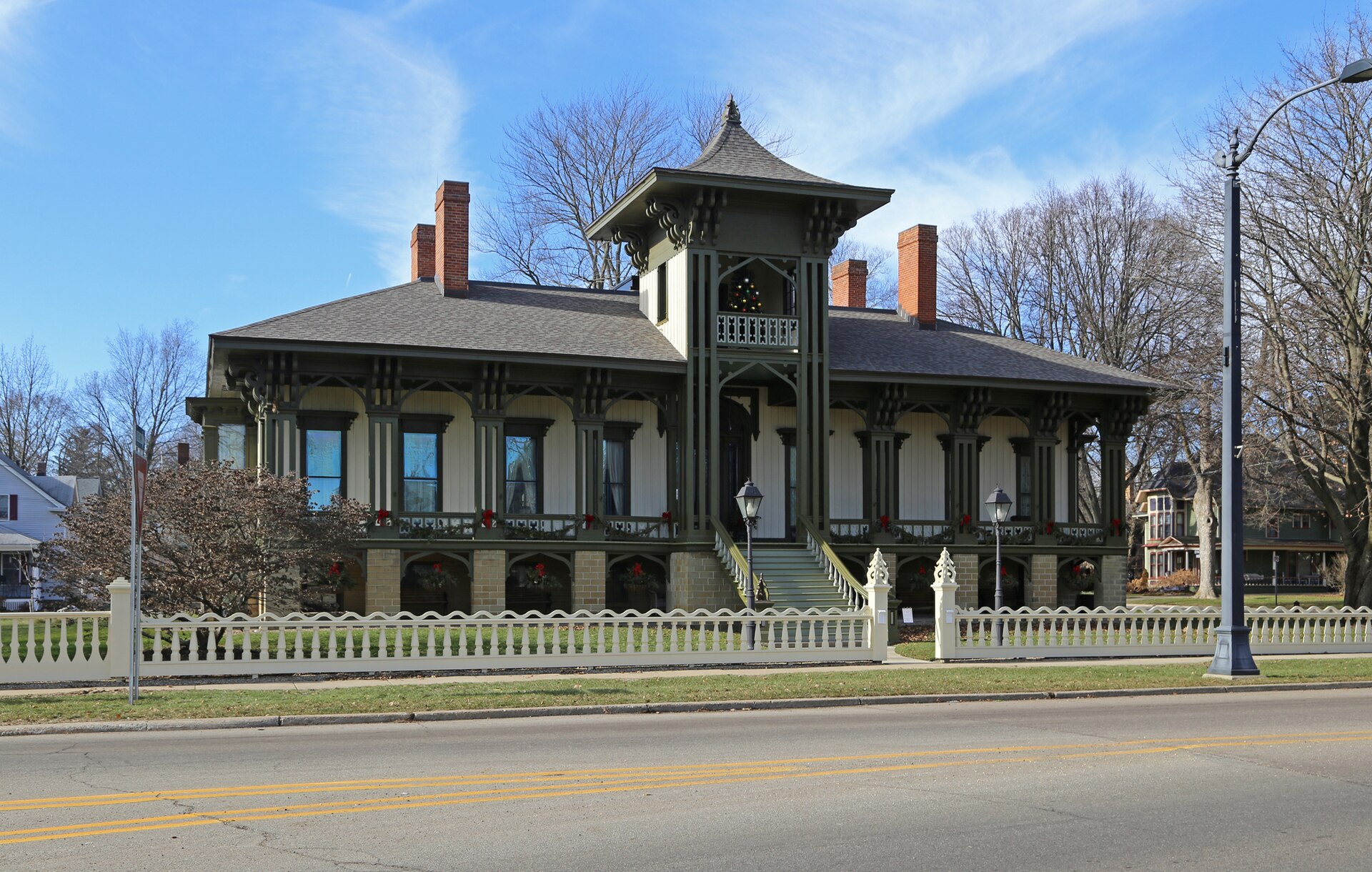
At 107 N. Kalamazoo Avenue stands the strangest building in southern Michigan. The Honolulu House was built in 1860 by Abner Pratt, a former chief justice of the Michigan Supreme Court who had served as United States Consul to Hawaii and came home wanting to live in what he had left. It combines Italianate and Gothic Revival bones with a sprawling wraparound veranda and painted tropical interiors. The Marshall Historical Society acquired it in 1961 and runs it as a museum; it was listed on the National Register on July 8, 1970.
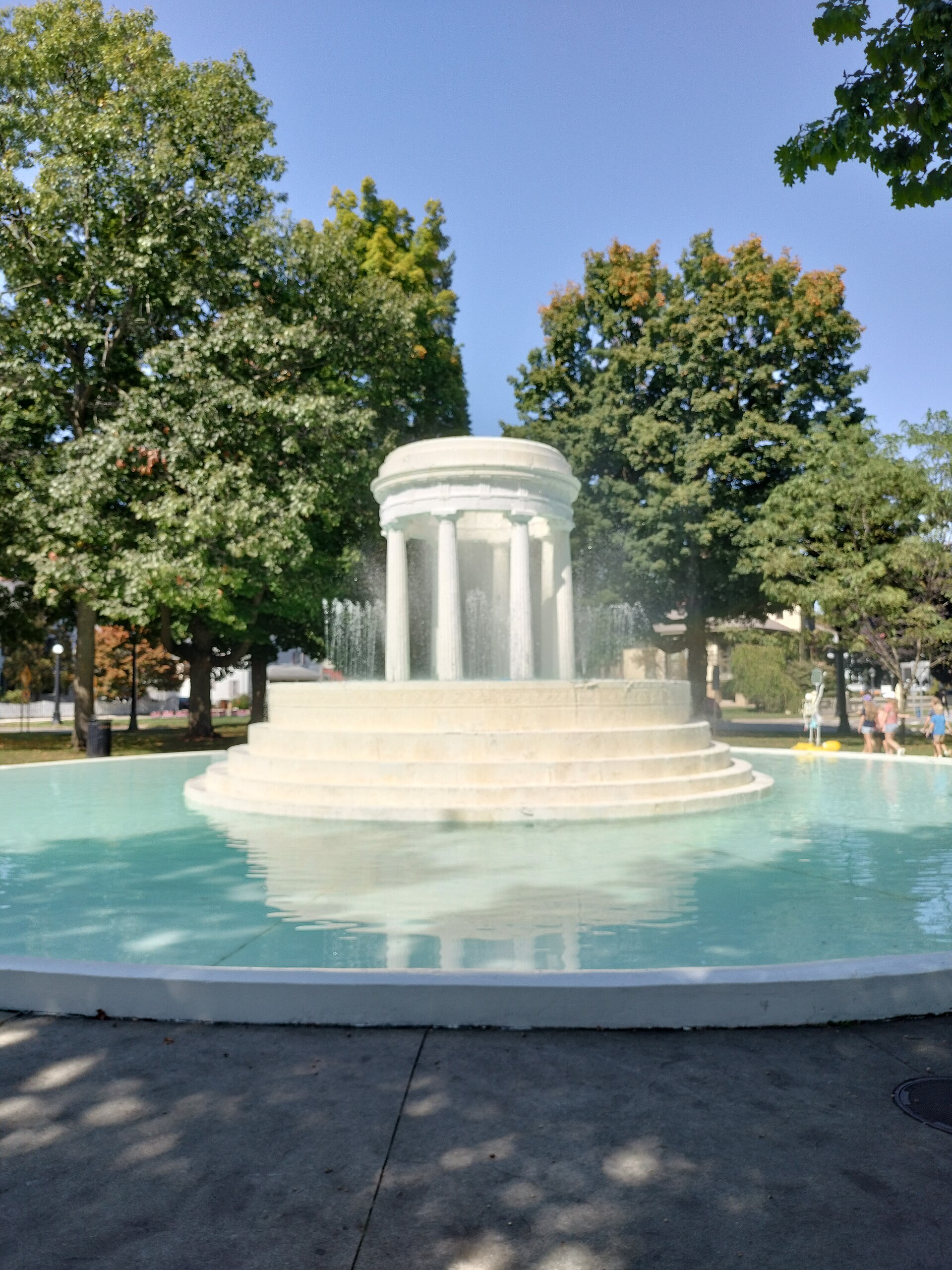
Two blocks away, at Michigan and Kalamazoo, is the Brooks Memorial Fountain. Harold C. Brooks built it in 1930 in memory of his father, Charles E. Brooks, and modeled it on the Temple of Love at Versailles: a Greek Revival rotunda of Doric columns with water and colored light inside. Architect Howard F. Young, landscape engineer Herman Swanson, and engineers from General Electric collaborated on it. At the dedication on April 26, 1930, a crowd of several thousand watched the mayor's son switch it on for the first time.
The fountain runs in the warm months and is lit after dark. It is the single most photographed object in Marshall and it deserves to be.
The Magic Museum
The American Museum of Magic sits at 107 East Michigan Avenue in an 1868 Victorian building that Robert and Elaine Lund restored themselves. It opened on April 1, 1978, which is exactly the sort of joke the founders would make, and it is described as the largest magic museum in the United States open to the public.
The collection is not a few posters in a case. It runs to roughly ten thousand books, twenty-four thousand magazines, forty-six thousand photographs, more than five thousand programs, and several hundred thousand pieces of ephemera. The objects on display include Harry Houdini's Milk Can and Overboard Box, Doug Henning's Zig Zag illusion, apparatus used by Howard Thurston, and a substantial holding of Harry Blackstone Sr. material.
Hours are limited and worth checking before you drive. This is a volunteer-supported institution in a small town, not a metropolitan museum with a staffed front desk seven days a week.
Riverwalk, Theater, and the Gasoline Museum
The Marshall Riverwalk is a raised boardwalk of about a mile and a half following Rice Creek and the Kalamazoo River. It is flat, it is shaded, and it is the right thing to do after a morning of house-gazing when someone in your party has had enough architecture.
The Franke Center for the Arts programs the town's live performance calendar, including productions by the Marshall Civic Players. The Walters Gasoline Museum occupies the former Marshall Interurban Railway depot, a 1903 building that has been left substantially as it was, and is devoted to Michigan's car and roadside culture.
Marshall also runs an unusually dense event calendar for its size: a blues festival, a historic home tour, a garden tour, an autumn SkeletonFest, and a Christmas parade. If your dates are flexible, look at the calendar first and then pick the weekend.
Battle Creek: Sojourner Truth
Battle Creek is twenty minutes west and the tone changes immediately. The most important thing in the city is not the cereal.
Sojourner Truth lived in and around Battle Creek for the last twenty-seven years of her life and is buried in Oak Hill Cemetery on Oak Hill Drive, under a white tablet marker. Downtown, near the bank of the Kalamazoo River, a twelve-foot bronze memorial dedicated on September 25, 1999 shows her at a lectern with her hand on a Bible. Visiting both in one afternoon is a short drive and a genuinely different experience from visiting either alone.
Battle Creek was a significant Underground Railroad community, and the city treats that history as central rather than incidental.
Cereal, Honestly
A word of warning, because a lot of travel writing has not caught up. Kellogg's Cereal City USA, the purpose-built cereal attraction, operated between 1998 and 2007 and is closed. Do not plan a day around it.
The cereal story is still tellable here, just not in one building. The Historic Adventist Village on the west side is a re-created nineteenth-century village spread across nearly three blocks, with an 1852 log cabin, a one-room schoolhouse, historic family houses, and a reconstructed 1857 meeting house. It exists to interpret the Adventist movement, and since the Kellogg brothers' sanitarium work grew directly out of that movement, it is where the health-food origins of American breakfast actually make sense.
The city's own identity as Cereal City is best absorbed by driving past the plants, eating downtown, and reading the markers. It is an industrial history, and industrial history is usually better told outdoors.
Binder Park Zoo
Binder Park Zoo is the one attraction in the pair that a family with young children will remember longest. It covers 433 acres south of Battle Creek, which is enormous for a zoo in a city this size, and the layout uses that space: habitats are large and separated by walking trail rather than packed along a loop.
The African section is the draw, and giraffe feeding is the specific thing children ask to do again. Lions, black bears, ostrich, reticulated giraffe, and snow leopard are among the animals people come for.
Budget half a day. The acreage is real and you will walk it.
Green Space and Birds
Leila Arboretum occupies 72 acres at 928 West Michigan Avenue in Battle Creek, holding on the order of 1,700 accessioned woody plants among roughly 25,000 total plantings. It is free to walk and it is the best hour of quiet in the city.
About twelve miles northwest, near Augusta, the W.K. Kellogg Bird Sanctuary is one of North America's pioneer wildlife conservation sites. W.K. Kellogg established it in 1927 as a refuge for migratory birds; Michigan State University owns and operates it now. It covers roughly 180 acres of varied habitat around 40-acre Wintergreen Lake, and it is deliberately built for close-up viewing rather than distant scanning.
In the city itself, the Linear Park Trail system connects neighborhoods and parks along the river and is the easiest way to get a walk or a ride in without driving anywhere.
How to Structure It
Two nights is the right length. Marshall has the better lodging character, including historic inns downtown, and it puts you inside the walking district; Battle Creek has more chain rooms and more restaurants open late.
A workable shape: arrive and walk Marshall's district in the late afternoon when the light is good on the fountain. Give the next morning to the Magic Museum and Honolulu House, then drive to Battle Creek for the afternoon and split it between Sojourner Truth's grave and the memorial. Give a full second day to Binder Park Zoo if you have children, or to the bird sanctuary and Leila Arboretum if you do not.
Everything named here is inside a forty-five-minute drive of either town. Albion is another ten minutes east of Marshall if you want a third downtown, and I-94 makes the whole area easy to reach from Detroit, Chicago, Kalamazoo, or Jackson.