In This Guide
A Region That Grows Its Own Pantry Morel Season: Michigan's Six-Week Obsession Beyond Morels: The Year-Round Wild Calendar The Michigan Truffle Almost Nobody Knows About The Rules: What You Can Pick, and What You Can Sell Sourcing Wild Ingredients Without a Basket Where Grand Rapids Buys Its Food Cooking What the Woods Gives You Common QuestionsWest Michigan is one of the more quietly abundant landscapes in the eastern United States, and most of the people living in it drive past that abundance twice a day without registering it. The same geography that made this a fruit belt — the lake-moderated climate, the sandy glacial soils, the hardwood stands running back from the shoreline through Allegan, Ottawa, Kent, and Newaygo counties — produces an enormous quantity of food that nobody planted. Morels in the old orchards and dying elms. Chanterelles under oak in July. Chicken of the woods erupting orange off a stump in August. Chaga on the birches all winter long. There is a full pantry out there, on a strict schedule, and it has been feeding people in this part of the state for a very long time.
This guide is about that pantry as it exists within roughly an hour of Grand Rapids — what comes up when, what the law actually permits, how the region's restaurants get hold of ingredients that cannot be ordered from a national distributor, and how a home cook without a foraging habit can end up with genuine Michigan chanterelles on a Tuesday. It is written for two audiences at once: the person who wants to walk into the woods in May and find something, and the person who would simply like to cook with this stuff and has no intention of learning to identify a false morel.
A Region That Grows Its Own Pantry
The productivity of this landscape is not an accident of luck; it is a direct consequence of how the ice left. The glacial retreat that carved out Lake Michigan deposited a patchwork of sand, gravel, and till across the western counties, and the lake itself now moderates the temperature swings that would otherwise wreck a delicate spring. That combination — well-drained soils, a long shoulder season, reliable moisture — is exactly why the fruit belt runs where it does along the Lake Michigan shore, and it happens to be equally favorable for the fungi that live in association with hardwood roots and decaying wood.
What makes the region unusual is the sheer variety of habitat compressed into a short drive. Within an hour of downtown Grand Rapids you can move from lakeshore dune-and-swale through the oak-hickory uplands of Allegan County's fifty thousand acres of state game area, into the river-bottom floodplain along the Grand, the Rogue up past Rockford, and the Muskegon out toward Newaygo. Each of those habitats produces a different set of species on a different schedule. A forager who understands three habitats instead of one effectively triples the length of their season, which is the actual skill in this pursuit — not finding mushrooms, but knowing where to be standing in the third week of May versus the second week of September.
Morel Season: Michigan's Six-Week Obsession
Nothing else in Michigan's outdoor calendar generates the specific mania that morel season does, and the reasons are structural. Morels resist commercial cultivation almost completely — efforts to grow them at scale have rarely succeeded, and the commercial trade still depends overwhelmingly on wild harvest. That single fact governs everything downstream: the scarcity is real, the price is real, and the only way to reliably get them is for someone to physically walk the woods and find them. Combine genuine scarcity with a season that lasts a few weeks and closes without warning, and you get a subculture that treats GPS coordinates as inheritable property.
The timing follows soil temperature north like a slow wave. In an average year the southern counties start producing in the second half of April, the Grand Rapids latitude comes in through early and mid-May, the northern Lower Peninsula peaks in the second half of May, and the Upper Peninsula can still be producing into early June. That progression is the reason experienced hunters can stretch a three-week local window into six weeks of picking by simply driving north as the season moves. It is also why any calendar date you read should be treated as a rough guide — a cold, dry spring shifts everything late, and a warm wet one can compress the whole thing into ten frantic days.
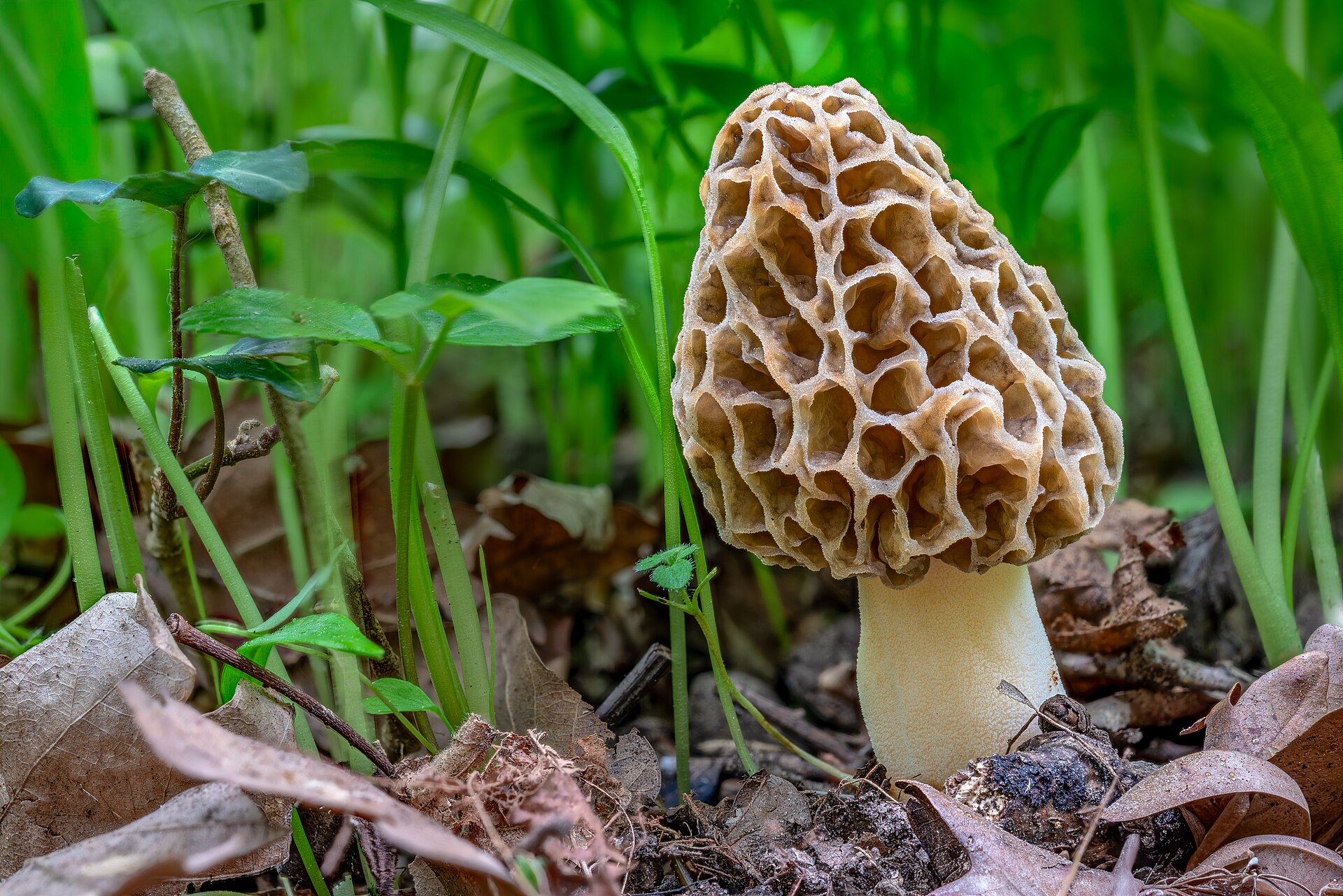
Habitat matters more than dates. Morels associate with a specific and fairly short list of trees: ash, elm — especially dead and dying elms, which are abundant in Michigan for grim reasons — sycamore, tulip tree, cottonwood, and old apple orchards, of which West Michigan has an enormous number in various states of abandonment. Yellow morels favor deciduous ground; black morels lean coniferous and typically run earlier. South-facing slopes warm first and produce first. The genuinely dangerous confusion is with false morels, which have a lobed, brain-like cap rather than the true morel's pitted honeycomb and are not hollow when sliced lengthwise. Slicing every specimen top to bottom takes two seconds and settles the question — a true morel is completely hollow inside, stem and cap as one continuous chamber. Our full morel hunting guide covers the festivals and the technique in far more depth.
Beyond Morels: The Year-Round Wild Calendar
The fixation on morels obscures the fact that Michigan's wild season barely stops. Chanterelles (Cantharellus species) come on in summer, generally July into August, appearing on the ground in association with oak and beech, golden-orange and apricot-scented with false gills that run down the stem rather than the true blade-like gills of a dangerous lookalike. Black trumpets (Craterellus) overlap with them and are far harder to see — dark, thin-fleshed, essentially invisible against leaf litter until your eye adjusts, at which point they are suddenly everywhere. Both dry exceptionally well, which is why they are among the most common wild mushrooms sold in preserved form.
Chicken of the woods arrives from midsummer into fall as shelving orange-and-yellow brackets on hardwood, and Michigan produces two distinct species worth knowing apart: Laetiporus sulphureus, the yellow-bellied form that grows on standing trunks, and Laetiporus cincinnatus, the white-bellied form that grows in rosettes at the base of oaks and is generally considered the better of the two. Lobster mushrooms (Hypomyces lactifluorum) are the strangest thing on the list — not a mushroom at all in the ordinary sense, but a parasitic fungus that colonizes a host Russula or Lactarius, turning it brilliant orange-red, dense, and seafood-scented in the process. Autumn brings hen of the woods at the base of old oaks, and then winter opens the season most people never think about.
Winter belongs to chaga (Inonotus obliquus), the blackened, burnt-looking conk that grows on living birch and is harvested through the cold months when the trees are easy to read and the woods are open. It is not eaten as a vegetable — it is broken up and simmered into a dark, faintly vanilla-bitter tea. Turkey tail (Trametes versicolor), the ubiquitous banded bracket fungus on fallen hardwood, is likewise a tea and preparation ingredient rather than a dinner mushroom. There is also a small tradition of tree saps and barks in this region beyond the obvious maple — birch, tapped later than maple and reduced at a dramatically higher ratio, and spruce tips and sap, which carry a resinous citrus note that has quietly become a favorite of Midwestern pastry kitchens.
The Michigan Truffle Almost Nobody Knows About
Michigan has a native truffle. Not a European import, not a novelty — a genuine, indigenous Tuber species called Tuber canaliculatum, known variously as the Michigan truffle or the Appalachian truffle, brick-red in color and native to eastern North America including the Great Lakes region. It is foraged and used in regional cuisine, dogs have traditionally been employed to locate it the same way they are in Périgord, and there has been real interest in developing cultivation methods for it.
The reason almost no one in Grand Rapids has cooked with one is straightforward: truffles fruit underground, which makes them essentially impossible to find by walking around looking down. Without a trained dog, the odds of stumbling across one are close to zero. This is the clearest example of a broader point about wild foods in this region — the barrier is rarely that an ingredient does not exist here, and almost always that finding it requires a specific skill, a specific season, and a specific piece of ground. A native Michigan truffle on a Michigan menu ought to be an easy story to tell, and the only thing standing in the way is the retrieval problem.
The Rules: What You Can Pick, and What You Can Sell
Michigan's foraging framework is more permissive than most people assume and stricter in exactly one place that matters commercially. On the permissive side: the Department of Natural Resources allows a range of wild foods to be harvested from public lands for personal use, specifically including mushrooms, nuts, berries, and tree fruits. Michigan has millions of acres of state forest, and morel hunting on it is a completely legitimate activity requiring no permit for personal consumption.
The restrictions are pointed. Foraging is not permitted where the plant is destroyed or damaged upon harvest, which removes an entire category of popular wild foods from public land: ramps — wild leeks, the spring allium everyone wants — and fern fiddleheads are explicitly off-limits on public lands for exactly this reason, along with any plant killed by harvesting it. Wild ginseng is a threatened species and federally protected. Trees may not be tapped for syrup on public land; maple sap is a private-property harvest only. Prohibited and restricted invasive species may not be possessed at all. And no forager should ever be on private property without the landowner's permission, which in practice is how most of the serious picking in West Michigan actually happens.
Then the commercial line, which is the single most important paragraph in this guide for anyone running a restaurant. Foods harvested from Michigan state lands are for personal use only and may not be resold — full stop. Separately, the sale of wild mushrooms harvested elsewhere is regulated through training and certification administered by the Michigan Department of Agriculture and Rural Development. Michigan's Food Code requires that wild-picked mushroom species be obtained from a source where each mushroom is individually inspected and found to be safe by a certified mushroom identification expert. That certification comes through a course such as the one offered by Midwest American Mycological Information, is earned by examination, and must be renewed. If you buy wild mushrooms for a commercial kitchen in this state, that is the question to ask your supplier, and a serious supplier will have a ready answer.
Sourcing Wild Ingredients Without a Basket
Which brings us to the practical problem. Wild ingredients are seasonal, weather-dependent, geographically scattered, legally constrained on resale, and require expert identification. Almost nobody running a kitchen — or a household — has the time or the standing to solve all of that personally. The answer, here as in Périgord or the Pacific Northwest, is that somebody else does the walking.
The Gourmet Gleaner is a wild-foods operation based in Wayland, a short run south of Grand Rapids on US-131, working the West Michigan woods and serving the Grand Rapids area as its regular territory. The catalog reads like the seasonal calendar above, because that is precisely what it is: dried morels (Morchella spp.), dried chanterelles (Cantharellus spp.), dried black trumpets (Craterellus spp.), both bellies of chicken of the woods — Laetiporus sulphureus and Laetiporus cincinnatus — lobster mushroom (Hypomyces lactifluorum), chaga (Inonotus obliquus), turkey tail (Trametes versicolor), and the Michigan truffle (Tuber canaliculatum) itself. Alongside the fungi sit spruce sap, a birch loose-leaf tea and a spicebush loose-leaf tea, and a run of dried culinary basils — holy basil, blue spice, lemon, and cinnamon basil flowers.
The operational detail worth understanding, whether you are a chef or a home cook, is that this supply does not work like a distributor's. There is no warehouse with a standing quantity of chanterelles in it. There is a season, a yield that depends on how much it rained in July, and a finite quantity that gets allocated in the order it was requested. That is why the business asks restaurants to reserve a season ahead rather than calling in an order for next Thursday — a kitchen that commits in advance gets built into the harvest plan, and a kitchen that calls during peak season gets whatever is genuinely left. For anyone designing a menu around Michigan ingredients, planning against the harvest calendar rather than the delivery calendar is the whole discipline.
Where Grand Rapids Buys Its Food
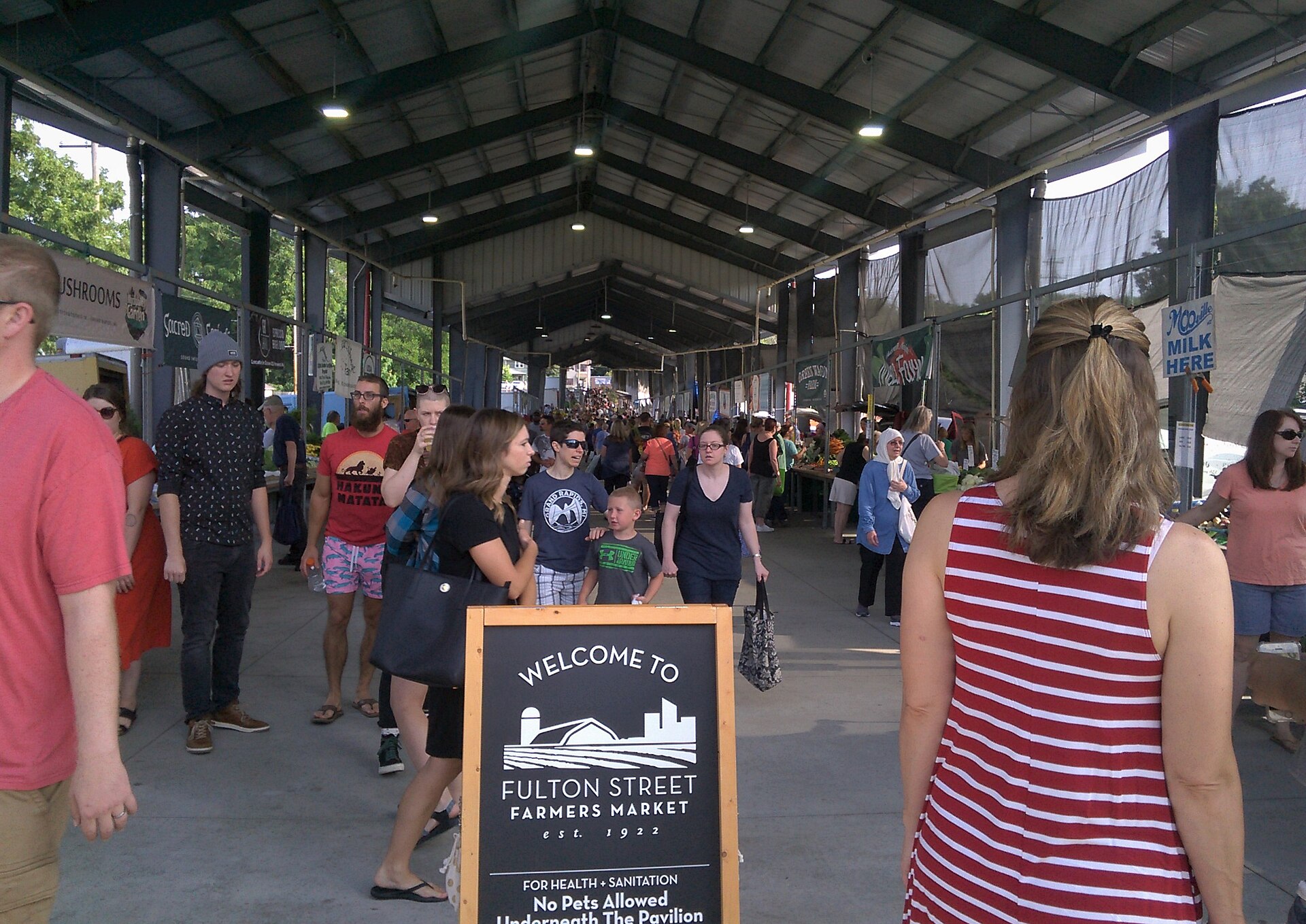
Grand Rapids has an unusually deep local-food infrastructure for a city its size, and it is worth knowing the landscape. The Fulton Street Farmers Market on the east side is the oldest and largest in the city, established in 1922 in response to food prices during the industrial boom and still operating on its original ground, running well over a hundred vendors through peak season. The Downtown Market on Ionia Avenue opened in September 2013 as a year-round indoor hall built specifically to give independent food businesses a permanent home, and now houses more than twenty tenants alongside outdoor vendor space and a rooftop greenhouse.
This matters to the wild-foods question because both institutions have spent decades training a customer base to think in terms of season and provenance — to expect asparagus in May and not in November, and to ask where something came from. That is the same mental model wild ingredients require, only more so. A city that already understands why the strawberries are only good for three weeks is a city primed to understand why the chanterelles arrive when they arrive. It also explains why West Michigan kitchens have been comparatively willing to build menus around ingredients they cannot order year-round, in a way that would be a much harder sell in a market without that grounding. For the broader food-and-drink picture, our downtown Grand Rapids guide covers the brewery scene that made the city's reputation.
Cooking What the Woods Gives You
A few principles carry across nearly everything on the list. Wild mushrooms should be cooked thoroughly — this is not a category where anything gets eaten raw, and morels in particular contain compounds that make them genuinely unpleasant, sometimes worse, if undercooked. Dried mushrooms want rehydration in warm water for twenty to thirty minutes, and the resulting soaking liquid is the most concentrated ingredient in the whole exchange; strain it to catch grit and use it as stock, because pouring it down the drain throws away most of what you paid for. Dried chanterelles and black trumpets in particular give up an enormous amount of flavor into that water.
Match intensity to intensity. Morels are delicate and floral and belong with cream, butter, eggs, and asparagus — a straight sauté in butter finished with a splash of sherry is still the best thing anyone has figured out to do with them. Black trumpets are the opposite: dark, almost smoky, powerful enough to stand up to beef or a strong cheese, and startlingly good ground to powder and folded into a pasta dough. Chicken of the woods holds a firm, genuinely poultry-like texture that takes a hard sear and stands in for meat convincingly. Lobster mushrooms are dense and hold up in a chowder or a rich cream sauce where a softer mushroom would disappear. Chaga and turkey tail are not dinner at all — they are simmered a long time and drunk. And spruce sap, used with restraint, does something to a dessert that nothing else in a Michigan pantry can do.
Common Questions
When should I look for morels near Grand Rapids? Generally early to mid May at this latitude, with southern Michigan starting in late April and the northern Lower Peninsula and U.P. running later into May and early June. Soil temperature and rainfall move the window every year, so treat dates as approximate and watch conditions.
Can I sell mushrooms I picked on state land? No. Food harvested from Michigan state lands is for personal use only and may not be resold. Commercial sale of wild mushrooms from other land is separately regulated through MDARD certification.
Are ramps legal to dig in Michigan? Not on public land. Ramps are killed by harvest, and Michigan does not permit taking plants from public lands where the plant is destroyed or damaged in the process. The same rule covers fern fiddleheads.
What should a restaurant ask a wild-mushroom supplier? Whether the mushrooms have been individually inspected by a certified mushroom identification expert, as Michigan's Food Code requires. It is a direct question with a direct answer, and it is the compliance line that matters.
Is there really a truffle native to Michigan? Yes — Tuber canaliculatum, the Michigan or Appalachian truffle, is native to eastern North America including the Great Lakes region and is genuinely foraged and eaten. It fruits underground, which is why it is rarely found without a trained dog.