In This Guide
The Inn That Henry Ford Rebuilt Anatomy of a Murder The Lighthouse and the Lake Superior Shore Practical Notes for the Drive NorthTwenty-eight miles north of Marquette, the pavement of County Road 550 runs out of towns to connect and simply stops at Big Bay, a settlement of a few hundred people wedged between Lake Independence and the Lake Superior shore. It is the kind of place that ought to be an unremarkable footnote — a former lumber town at the end of a dead-end road, backed by the roadless bulk of the Huron Mountains. Instead, Big Bay holds two genuinely outsized claims on American cultural history: it was the private northern refuge of Henry Ford, who rearranged the village's physical geography to suit his preferences, and it was the setting of a 1952 murder that became one of the most acclaimed courtroom films ever made. Visitors come for the remoteness and stay for the improbable density of story packed into so small a place.
The Inn That Henry Ford Rebuilt
The building now known as the Thunder Bay Inn went up in 1911 as a lumber warehouse and store, a purely utilitarian structure serving the timber operation that gave Big Bay its reason to exist. Henry Ford bought it in 1940 and converted it into a private vacation retreat, and the motivation behind that purchase is one of the more revealing anecdotes in Michigan's industrial history. Ten miles up the shore sat the Huron Mountain Club, an intensely exclusive preserve whose membership rolls included Ford's friends Thomas Edison and Harvey Firestone. Ford wanted in. The club's old-money membership, unimpressed by the vast but recently acquired Ford fortune, declined to have him. So Ford bought a building in the nearest village, turned it into a hotel of his own, and began inviting his friends north for weekends on his own terms.
Having secured the property, Ford proceeded to treat the surrounding village as an extension of it. Discovering that the railroad depot interrupted his view of Lake Independence from the second-floor balcony, he had the depot moved down the hill. He then relocated the road, several houses, and the Catholic church. It is a story that says a great deal about both the man and the era, and standing on that same balcony today, looking out over an unobstructed sweep of water, a visitor gets a uniquely concrete sense of what industrial-scale wealth could accomplish when it turned its attention to a small problem. The inn still operates, and the view Ford went to such lengths to secure remains its principal selling point.
Anatomy of a Murder
In 1952, a lieutenant stationed nearby shot and killed the proprietor of a Big Bay tavern, and the resulting trial became the basis for a novel written by John D. Voelker, a Michigan Supreme Court justice writing under the pen name Robert Traver. In 1959, Otto Preminger brought a film crew to the village to adapt it, and the resulting picture — starring James Stewart and Lee Remick — was shot substantially on location in the very community where the events had occurred. The building, then operating as the Big Bay Hotel, served as a set. Because the property had no bar at the time, the production built a single-storey tavern extension for filming, and that addition was subsequently preserved rather than demolished, so visitors can still walk into a room that exists only because a film crew needed it to.
The film's reputation has grown steadily in the decades since. Its frank courtroom treatment of a subject matter that was startling for 1959, its Duke Ellington score, and Stewart's performance as a small-town lawyer have kept it in circulation among people who have never heard of the Upper Peninsula. For visitors, the appeal is the unusual completeness of the setting: the town, the tavern, the roads, and the surrounding country are all recognizable, and the gap between the film's world and the present-day village is narrower than it has any right to be after seven decades. Marquette-area tourism materials treat the connection as a genuine draw, and it rewards a viewer who watches the film before making the drive north.
The Lighthouse and the Lake Superior Shore
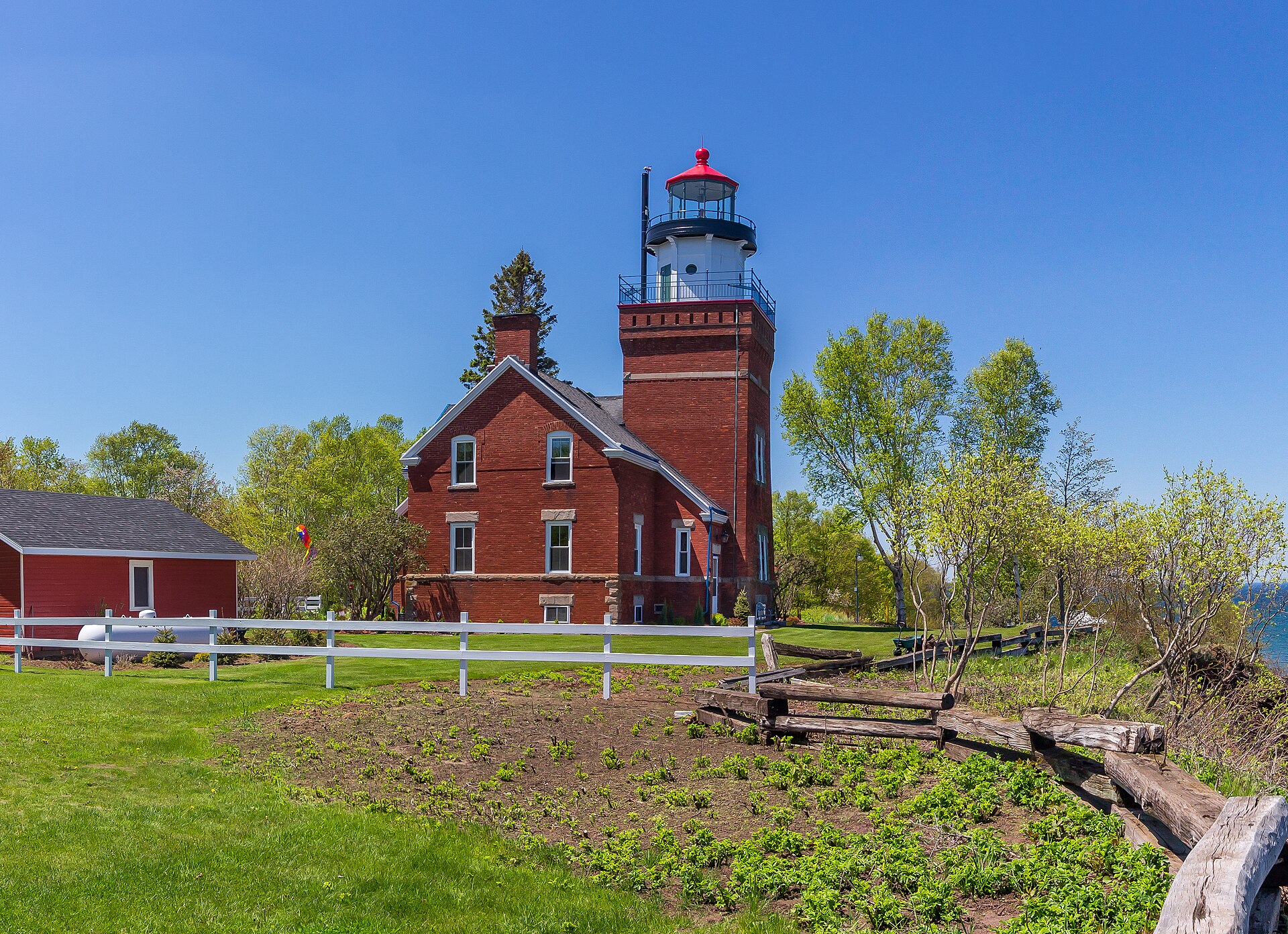
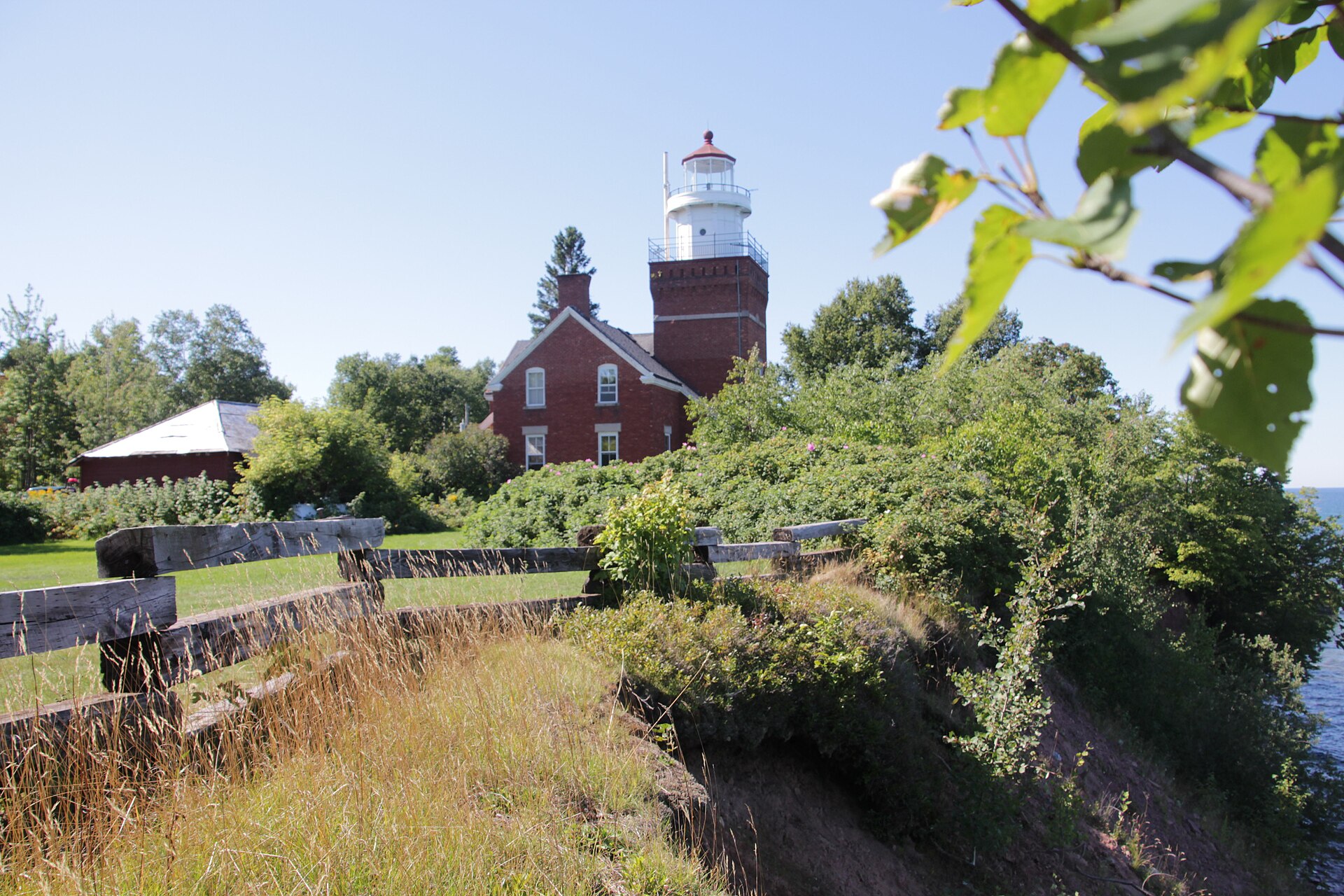
Big Bay Point Lighthouse stands on the headland north of the village, overlooking Lake Superior from a bluff that gives the structure a commanding sweep of open water. The setting is genuinely dramatic — Superior is the coldest and least forgiving of the Great Lakes, and a light positioned on an exposed point of the southern shore was answering a real and continuous need rather than marking a decorative harbor entrance. The building has since found a second life as lodging, which makes it one of a small number of Michigan lighthouses where a traveler can actually sleep rather than simply photograph the exterior and move on.
The shoreline around Big Bay repays unhurried exploration. Lake Independence sits immediately inland, providing calmer and considerably warmer water than Superior ever manages, and the contrast between the two — a friendly inland lake and a vast cold sea, separated by a strip of land — is one of the defining characteristics of this stretch of coast. Beyond the village to the west rise the Huron Mountains, a largely roadless block of ancient highland that includes some of the least disturbed forest in the eastern United States. Much of that country is private and closed to the public, a fact worth understanding before setting out; the accessible portions are reached from the surrounding national and state forest land rather than by driving into the club's holdings.
Practical Notes for the Drive North
Big Bay is a genuine end-of-the-road destination, and the practical consequences deserve attention before departure. County Road 550 from Marquette is paved and scenic but carries no services along most of its length, so fuel, groceries, and any necessary supplies should be handled in Marquette rather than assumed to be available at the far end. The village supports a small cluster of lodging and dining, but the inventory is limited and seasonal patterns are pronounced; a summer Saturday and a February Tuesday present entirely different pictures of what is open. Winter brings serious lake-effect snow, and the road, while maintained, demands respect and appropriate tires.
The reward for that modest planning burden is a village that has resisted the transformation into a resort town that has overtaken so much of northern Michigan's shoreline. Big Bay remains small, quiet, and largely uncommercialized, and the ratio of story to population is remarkable — a Ford retreat, a landmark film, a working lighthouse, and the edge of one of the wildest landscapes in the Midwest, all within a few miles of a single intersection. Travelers who value that combination over convenience will find the drive north from Marquette to be one of the more rewarding dead ends in the state.