In This Guide
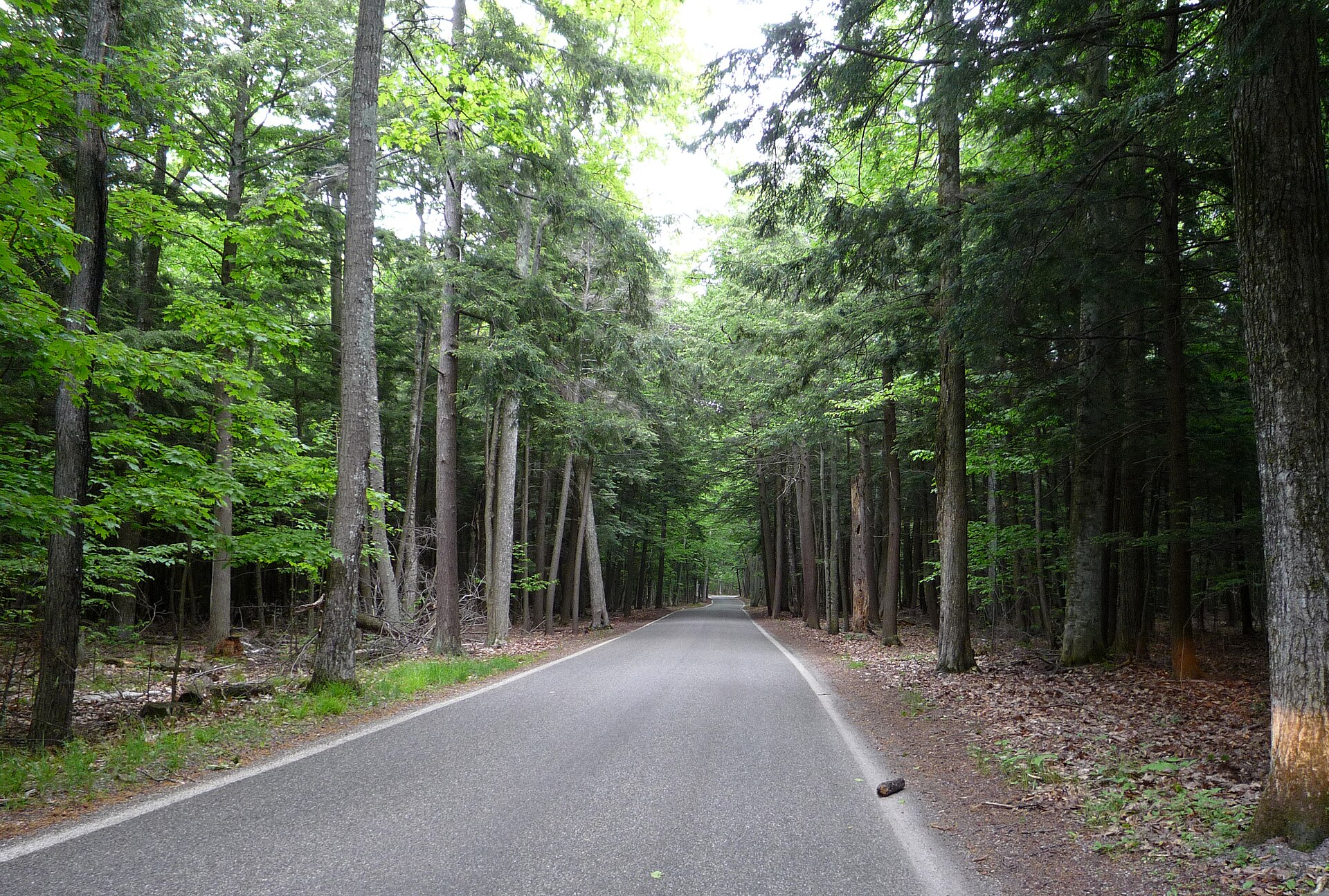
A Road With No Centerline Harbor Springs to Good Hart Cross Village and Legs Inn Season and TimingMichigan has one state highway with no centerline painted on it, and there is a reason: M-119 north of Harbor Springs is too narrow to divide. The road runs about twenty miles along a Lake Michigan bluff to Cross Village, threading a corridor of oaks, maples, birch, and cedar so dense that the canopy closes overhead for miles at a stretch — which is how the Tunnel of Trees got its name and its reputation as one of the most scenic stretches of pavement in the country. It follows the line of an old Ottawa trail, it has hairpin turns that RVs and large vehicles genuinely should not attempt, and it can be driven end to end in under an hour. Almost nobody does. The whole point is to stop.
A Road With No Centerline
The absence of a painted centerline is not a maintenance oversight but an accurate description of the road's width. M-119 through this stretch is a genuinely narrow two-lane, winding along the top of a bluff with hairpin turns, blind curves, and shoulders that range from minimal to nonexistent. Michigan Department of Transportation guidance and every local source agree on the practical consequence: this is not a route for recreational vehicles, trailers, or anything large, and drivers of ordinary cars should still expect to slow well below the posted limit and meet oncoming traffic closer than they are used to.
That constraint is the source of the experience rather than an obstacle to it. A wider, straighter, better-engineered road would have required clearing the trees back from the pavement, and the tunnel effect would have vanished with them. What survives here is essentially a nineteenth-century alignment that was never modernized — the road follows the old Ottawa trail closely enough that its curves reflect terrain and habit rather than survey lines. Drivers who arrive expecting a scenic highway and find a lane-and-a-half of pavement in a green tube have not encountered a problem; they have arrived.
Harbor Springs to Good Hart
The drive should be taken northbound from Harbor Springs, and this is not merely a preference — the lake views open up more consistently heading north, and the sequence of stops builds better in that direction. Harbor Springs itself is a harbor town of considerable wealth and considerable charm at the foot of Little Traverse Bay, and it supplies the last reliable full-service provisioning before the corridor. Fuel here rather than assuming an option further along.
North of town the canopy closes and the road begins its work. The Woolam Family Nature Preserve offers one of the few substantial public access points to the shoreline along this stretch, protecting roughly four thousand feet of Lake Michigan beach below the bluff — a genuinely valuable thing on a coast where nearly everything is private. Middle Village and Good Hart follow, both very small, and the Good Hart General Store has become the corridor's unofficial waypoint. It functions as store, deli, post office, and gathering place at once, and stopping there is as much a part of the drive as the trees are.
Cross Village and Legs Inn
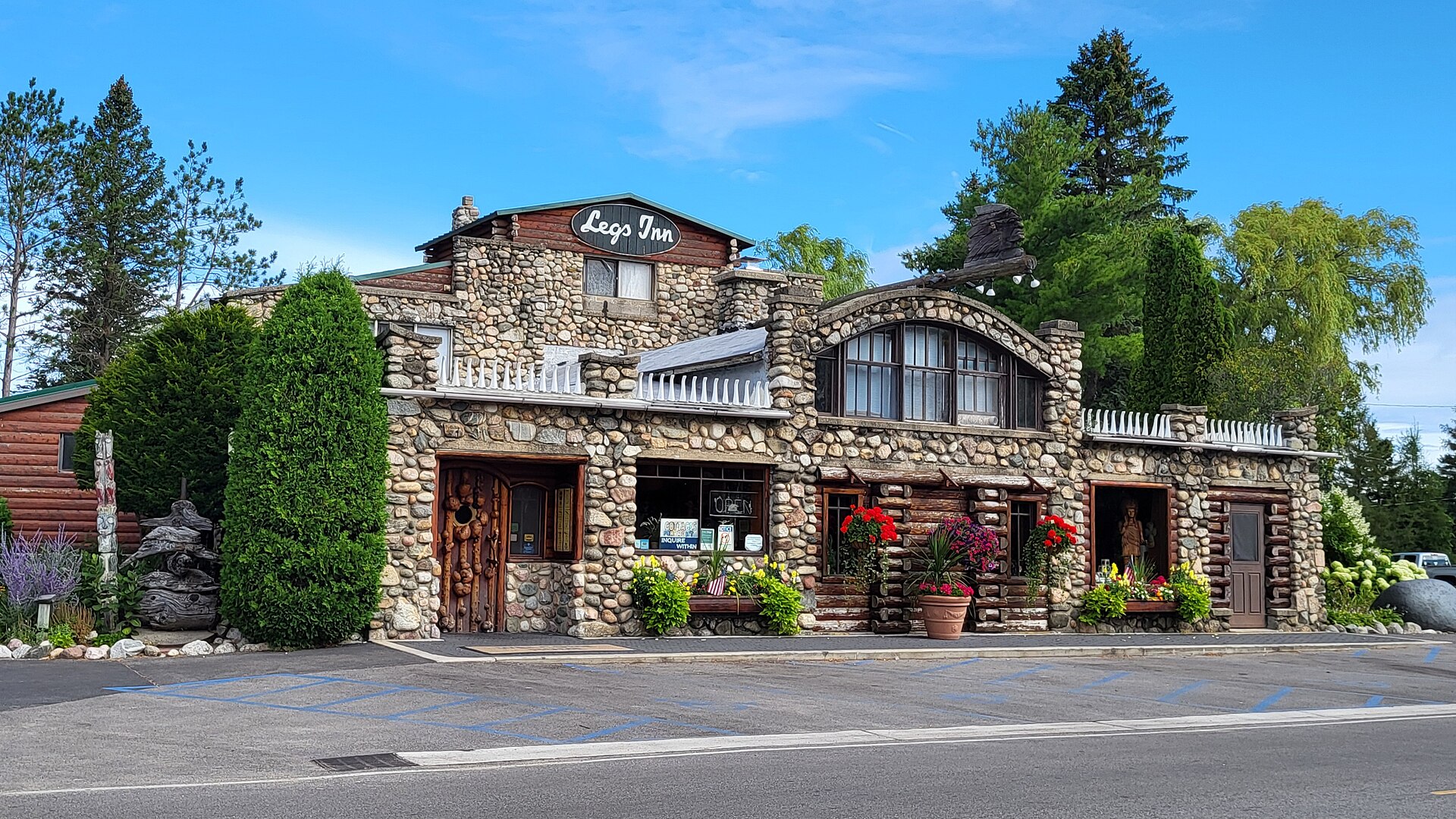
The tunnel ends at Cross Village, and what waits there is one of the more improbable buildings in Michigan. Legs Inn takes its name from the row of inverted cast-iron stove legs trimming its roofline, and the structure behind that detail is genuinely singular. Stanley Smolak, a Polish immigrant who came to the United States in 1912 and settled in Cross Village in 1921, built it during the 1930s from locally gathered stone and timber — work carried out with the labor and craftsmanship of Odawa and other area residents, a collaboration the building's historical marker credits directly. A self-taught artist, Smolak carved fantastical creatures from tree roots, limbs, and driftwood for the furniture and decorative objects inside, calling them "nature's oddities."
Smolak kept working on the place until his death in 1968 at eighty-one, by which point it had become a social center for the community, and his family has now run it for more than ninety years. It serves Polish food, it overlooks Lake Michigan, and it has no real analogue anywhere else in the state — a folk-art structure that also happens to be a functioning restaurant at the end of a famous road.
Arriving at Cross Village is the natural end of the northbound run, and travelers should plan the timing around it rather than treating it as an afterthought. The restaurant operates seasonally, as does most of the corridor, and showing up on a closing week or outside operating hours after twenty miles of anticipation is a genuinely deflating way to finish. From Cross Village a driver can continue north toward the Straits or turn back south through the tunnel, which looks entirely different in the opposite direction and in different light.
Season and Timing
Fall is when this drive earns its reputation. The hardwood canopy that forms the tunnel turns in late September and early October, and the effect of driving miles beneath an unbroken ceiling of color is the single image that sells northern Michigan every autumn. It is correspondingly the busiest period, and on a peak color weekend the road can carry more traffic than its geometry comfortably allows — an early weekday morning during color season is worth arranging if at all possible.
Spring deserves more attention than it gets. Before the canopy fills in, the forest floor along the corridor produces miles of trillium, a carpet of white beneath bare or budding trees that is arguably more distinctive than the fall color and draws a fraction of the crowd. Summer is green and pleasant and busy; winter empties the road entirely, closes most of the businesses, and rewards travelers who want the tunnel to themselves and are equipped for a narrow, snowy, unlit road with no centerline. Whatever the season, the drive takes as long as a traveler allows it to — an hour without stopping, most of a day done properly.