Jackson holds a claim to national political history considerably larger than its present-day size might suggest: this is the city where, on a summer afternoon in 1854, a crowd of outraged citizens gathered beneath a stand of oak trees and founded what would become the modern Republican Party. That same city, in a considerably less celebrated twist of history, also spent much of the twentieth century as home to what was, at two separate points, the largest walled prison anywhere in the world, giving Jackson an unusually layered civic identity split between idealistic political founding myth and hard, literal incarceration infrastructure.
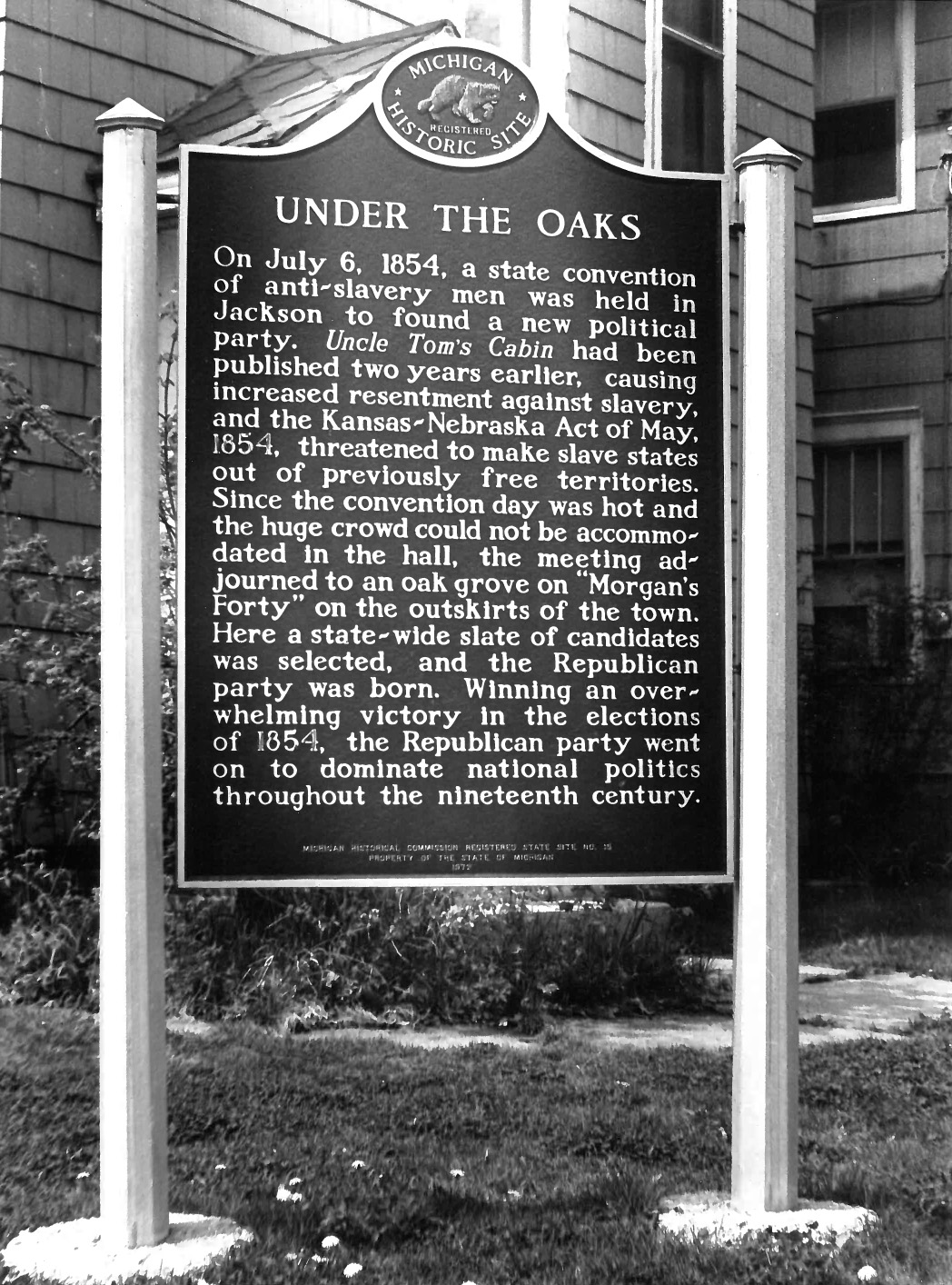
Under the Oaks
More than a thousand outraged citizens gathered in Jackson on July 6, 1854, assembling beneath a grove of oak trees specifically to denounce the recently passed Nebraska Act, a piece of federal legislation that threatened to open new American territories to slavery and that anti-slavery Michiganders found intolerable enough to warrant an entirely new political coalition. The convention that assembled that day drafted a platform and formally adopted the name "Republican," and the party born beneath those oak trees would, within just six years, capture the presidency itself and lead the country through the Civil War that many of the convention's original attendees had gathered specifically to help prevent through political rather than military means.
A monument commemorating the founding now stands at the site, dedicated in a 1910 ceremony attended by sitting President William Howard Taft himself, a testament to how seriously the party continued to regard its Jackson origins even more than half a century after the actual convention. The "Republican Oaks" have since become an enduring symbol invoked well beyond Michigan, and Jackson's claim to the founding, while occasionally disputed by a rival Wisconsin convention held earlier the same year, remains the version most thoroughly documented and most widely commemorated at the actual historical site.
The World's Largest Walled Prison, Twice Over
Michigan's first state prison opened in Jackson in 1838, and by 1882 its population had grown large enough, surpassing two thousand inmates, to make it the largest walled prison anywhere in the world, a distinction the original facility held until its 1934 closure and replacement by an even larger successor. That successor, the State Prison of Southern Michigan, eventually held capacity for more than fifty-seven hundred inmates, earning Jackson the same superlative distinction a second time under an entirely different building, a genuinely unusual repeat achievement for any single American city across two separate facilities built a century apart.
The newer prison operated until its 2007 closure, after which several film productions used the vacated cell blocks as shooting locations, and in 2014 the Ella Sharp Museum partnered with the Michigan Department of Corrections to convert a decommissioned section of the facility, known as Cell Block 7, into a self-guided museum documenting the prison's history. The original 1838 prison site has meanwhile been redeveloped into the Armory Arts Village, a residential and studio complex for working artists, giving Jackson two starkly different adaptive-reuse projects built atop the same underlying institutional history, one leaning into the prison story directly and the other quietly repurposing the ground for an entirely different kind of civic life.