In This Guide
The Man Who Gave the Town Its Name Copper Peak, the Western Hemisphere's Only Ski Flying Hill The World's Tallest IndianIronwood sits about as far west as Michigan geography permits, tucked into the Upper Peninsula's Gogebic Range so close to the Wisconsin border that many visitors arrive from Minnesota or the Twin Cities before they ever cross into the Lower Peninsula proper. The city takes its unusually direct name from a man rather than a metaphor: James "Iron" Wood, a mining prospector whose 1882 test pit uncovered the ore body that would become the Norrie Mine and, within a few short years, an entire boomtown built almost overnight around the wealth pulled out of the ground beneath it. What has outlasted the mines themselves is a curious and genuinely singular collection of civic landmarks, one of which happens to be unlike anything else on the North American continent.
The Man Who Gave the Town Its Name
Prospectors had already made camp along the nearby Montreal River as early as 1871, drawn by geological hints of iron in the Gogebic Range, but it was James Wood's 1882 test pit that finally located a deposit substantial enough to justify serious investment, and the Norrie Mine that grew out of that discovery quickly became one of the range's most productive operations. The Milwaukee, Lake Shore, and Western Railway Company recognized an opportunity when it saw one, extending a new line through the fledgling settlement in late 1884, and the arrival of reliable rail service transformed what had been a rough prospecting camp into a proper town almost overnight, with lumber, supplies, and eager workers arriving by the trainload.
Ironwood's official founding in 1885 coincided with a wave of immigration that would define the community's character for generations, as Finnish, Italian, and Polish families arrived in significant numbers to work the mines and, in the process, built churches, social halls, and neighborhood traditions that still shape the city's cultural fabric today. The mining economy eventually contracted through the 1920s, undone by a combination of factors including the rising cost of deep underground extraction and the Great Depression's collapse in industrial demand, but the immigrant communities that mining had assembled stayed on, adapting to new economic realities rather than dispersing when the ore ran thin.
Copper Peak, the Western Hemisphere's Only Ski Flying Hill
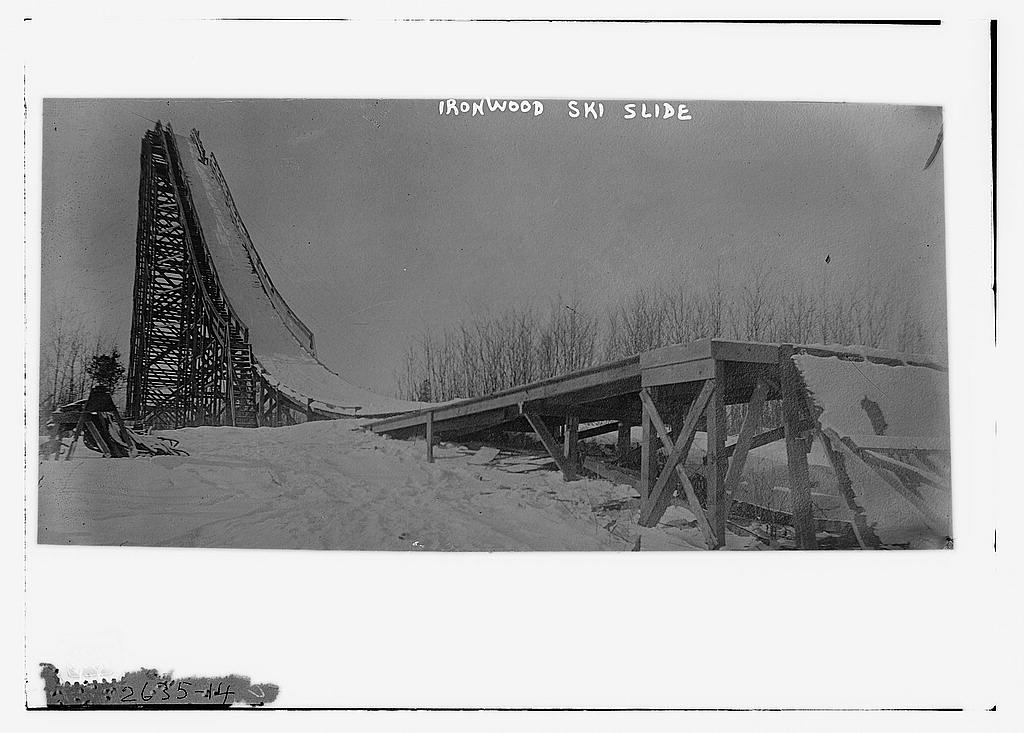
Ironwood's mining-era enthusiasm for hard physical risk found an unlikely second act in ski jumping, a sport the local Finnish and Scandinavian population took to with particular enthusiasm, and that tradition eventually produced Copper Peak, an enormous artificial ski flying hill that remains, to this day, the only facility of its kind anywhere in the Western Hemisphere. Ski flying differs from conventional ski jumping in scale alone: the hill is engineered to launch competitors far beyond what a standard Olympic jump permits, and Copper Peak's steel scaffolding, visible from a considerable distance across the surrounding hills, rises to a height that makes the sport's European-dominated history feel briefly, improbably, like it also runs straight through the Upper Peninsula.
Visitors who make the climb to the hill's observation deck, whether or not a competition happens to be underway, are rewarded with a panoramic view stretching across three states and Lake Superior on a clear day, a payoff substantial enough that Copper Peak draws sightseers with no particular interest in ski flying at all. The facility's operating schedule has fluctuated over the decades depending on funding and structural maintenance, but its silhouette alone has become one of the most recognizable landmarks in the western Upper Peninsula, an industrial-scale monument to a sport most Americans have never seen practiced anywhere else in the country.
The World's Tallest Indian
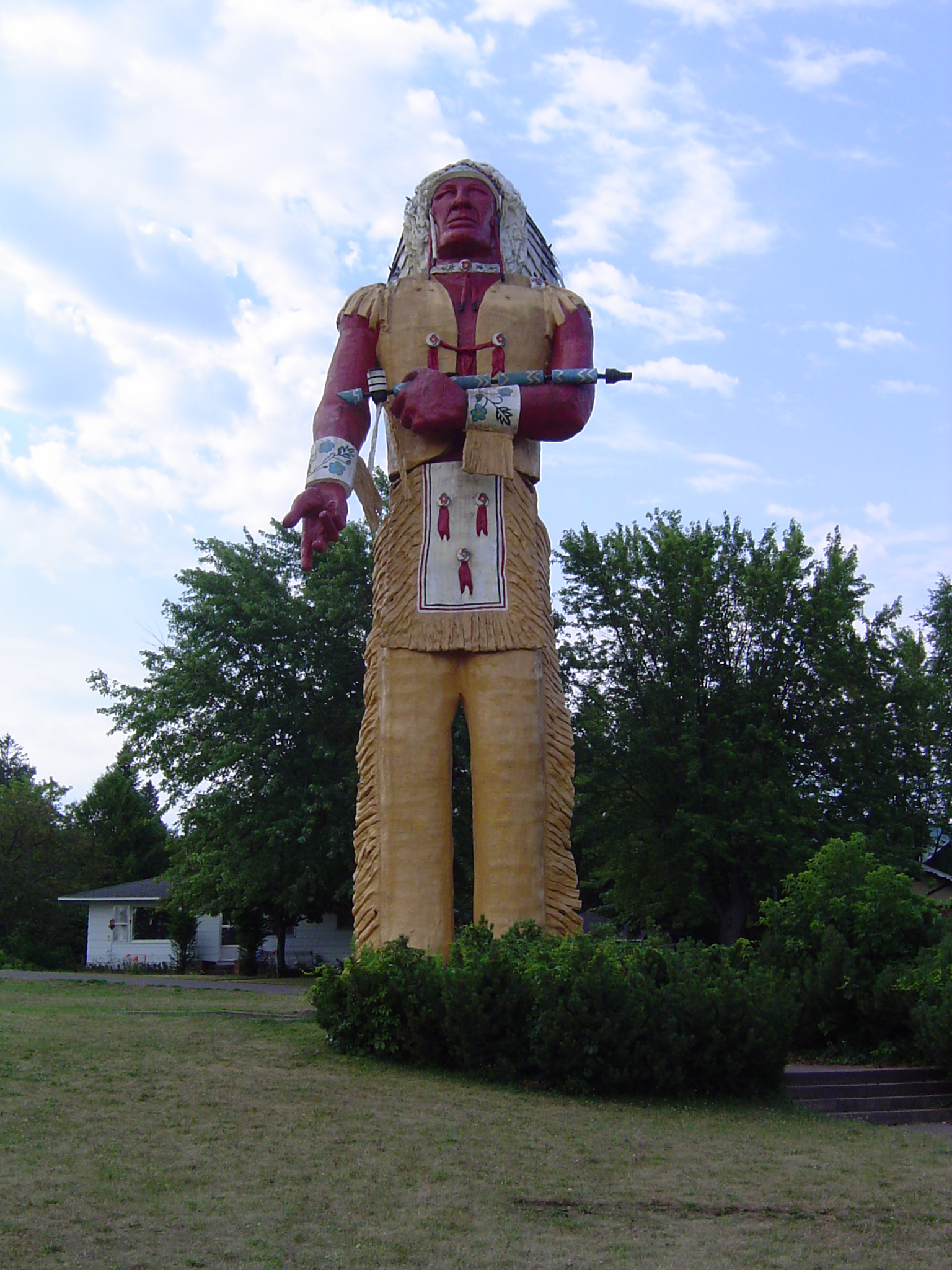
Downtown Ironwood is also home to a statue of Hiawatha so large, and so unapologetically of its mid-century roadside-attraction era, that it has earned the enduring nickname "the World's Tallest Indian" among generations of Upper Peninsula travelers. Rising several stories above the surrounding streets, the fiberglass figure has become exactly the kind of unpretentious, faintly surreal landmark that road-trippers seek out deliberately, less for historical accuracy than for the specific pleasure of standing beneath something so enormous and so entirely unexpected in a town of Ironwood's modest size.
The statue shares the town with a genuinely more substantial set of historical assets, including the Ironwood Area Historical Society Museum and the restored Ironwood Theatre, both of which offer a considerably more grounded look at the mining boom that built the city in the first place. Together, the earnest historical preservation and the cheerfully oversized roadside novelty give Ironwood a split personality that feels, on reflection, like an entirely honest representation of a town that has always balanced serious industrial history against a genuine sense of humor about itself.