In This Guide
The Charcoal Empire Henry Ford Built By Accident A Ski Jump Visible From the Highway The Chapin Mine's Astonishing Pump Piers Gorge, Where the Menominee Turns ViolentIron Mountain sits deep in the western Upper Peninsula's Menominee Iron Range, a landscape so thoroughly shaped by mining that the town's very name announces its origin story before a visitor has driven a single block past the city limits. For the better part of a century, ore hauled up from beneath these streets fed the furnaces of the Midwest, and the money it generated built a downtown of unexpectedly grand brick and stone buildings that still anchor a community of barely seven thousand people. But Iron Mountain's most surprising legacy has nothing to do with iron at all, and everything to do with a backyard barbecue staple that most Americans have never traced back to this particular corner of the woods.

The Charcoal Empire Henry Ford Built By Accident
In the 1920s, Henry Ford went looking for a reliable source of wood for the Model T's frames, floorboards, and dashboards, and he found it in the dense hardwood forests surrounding Iron Mountain and the neighboring town he would eventually help found, Kingsford. Ford's sawmill operation generated enormous quantities of wood scraps and sawdust as a byproduct of automobile production, and rather than let the waste go to landfill, Ford's cousin by marriage, Edward Kingsford, helped negotiate the land purchase and then oversaw a plant that compressed the leftover wood into charcoal briquettes. The operation was, in effect, one of the earliest and most successful industrial recycling programs in American history, decades before anyone used that particular vocabulary to describe it.
That briquette plant eventually became the Kingsford Charcoal Company, and though the brand's headquarters and manufacturing have long since moved on from Iron Mountain itself, the town of Kingsford still bears the name, and locals still tell the story with a mixture of pride and mild disbelief that the ubiquitous bag of charcoal at every American grocery store traces its lineage back to their patch of the Upper Peninsula. It is the kind of only-in-Michigan historical footnote that rewards visitors willing to ask a local shopkeeper why the next town over is called Kingsford in the first place.
A Ski Jump Visible From the Highway
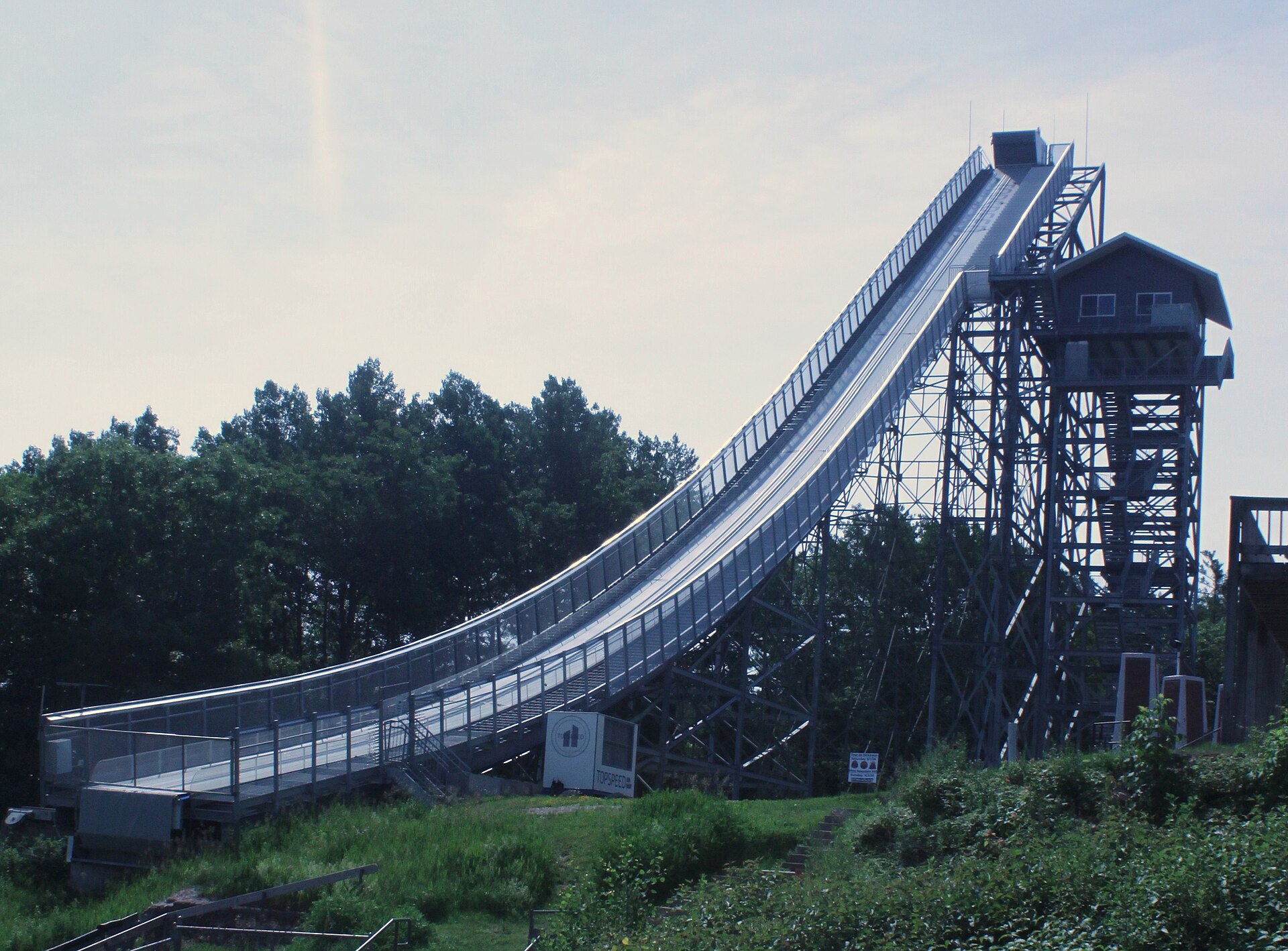
Long before it was fully complete, the Pine Mountain Ski Jump was already announcing itself to anyone driving into town, its steel scaffolding rising more than three hundred feet above the surrounding hillside like an industrial cathedral dropped into the North Woods. Built in stages starting in the 1930s and expanded through the decades since, it remains one of the largest ski jumps in the Western Hemisphere, capable of launching competitive ski jumpers well over four hundred feet through the air during the annual Pine Mountain Invitational, a competition that has drawn international-caliber jumpers to this unassuming Upper Peninsula town for generations.
Even travelers with no particular interest in winter sports tend to slow down for a look, since there is genuinely nothing else on the regional skyline that prepares you for the sight of a ski jump this size rising out of otherwise unbroken forest. In summer, when the jump sits quiet and skeletal against the sky, it takes on an almost sculptural quality, a monument to a very specific and very committed athletic subculture that has quietly persisted in Iron Mountain for the better part of a century.
The Chapin Mine's Astonishing Pump
A few miles outside town, in the tiny community of Vulcan, the Iron Mountain Iron Mine tour takes visitors four hundred feet underground into a genuine former mine shaft, riding the same kind of ore cars that once hauled workers into the darkness on shifts that could stretch far longer than any modern labor law would permit. The tour's centerpiece, though, is not underground at all: it is the Chapin Mine Pump, a colossal steam-driven pumping engine built in 1893 specifically to keep the mine's tunnels from flooding, and at the time of its construction it was the largest steam pumping engine ever built anywhere in the world.
The pump's single flywheel measures forty feet across, an almost incomprehensible scale for a piece of Victorian-era machinery, and seeing it in person tends to recalibrate a visitor's whole sense of what nineteenth-century industrial engineering was actually capable of producing. It ran continuously for decades, removing millions of gallons of groundwater a day, and its survival into the present gives Iron Mountain a genuinely rare artifact: physical proof, rendered in iron and steel, of just how much infrastructure it took to keep an Upper Peninsula mine dry enough to operate.
Piers Gorge, Where the Menominee Turns Violent
A short drive south of town, along the Michigan-Wisconsin border near the small community of Norway, the placid Menominee River abruptly changes personality at Piers Gorge, a roughly two-mile stretch where the river funnels through a narrow granite channel and drops over a series of rapids and low falls, the largest of which, Mishicot Falls, plunges about eight feet in a single churning drop. The gorge takes its name from natural rock 'piers' that the current tumbles over, and the whitewater here is serious enough that it hosted World Cup kayak racing through the 1980s and 1990s, drawing elite paddlers to a stretch of river that most Michigan visitors have never heard of, tucked away as it is in the state's least-populated corner.
A well-maintained trail on the Michigan side follows the gorge closely enough that hikers can watch commercial rafting trips punch through the standing waves without getting wet themselves, and the walk to the overlooks above Mishicot and Sand Portage Falls makes for one of the more dramatic short hikes available anywhere in Dickinson County, a genuine adrenaline landscape hiding a short drive from Iron Mountain's quiet residential streets.