In This Guide
The Chain Ferry and Mount Baldhead Oval Beach Saugatuck Dunes State Park The Dune Rides and the Galleries Season and LogisticsTwo small towns face each other across the Kalamazoo River a few miles inland from Lake Michigan, and between them they have built a reputation as Michigan's Art Coast — galleries, studios, and public installations at a density no comparable pair of West Michigan towns can match. What makes Saugatuck and Douglas work as a vacation base rather than an afternoon of gallery-hopping is what surrounds them: a beach ranked among the best in the world, a state park with two and a half miles of undeveloped Lake Michigan shoreline, a 302-step climb to a Cold War radar tower, and the last hand-cranked chain ferry operating in the United States.
The Chain Ferry and Mount Baldhead
The Saugatuck chain ferry is the last remaining hand-cranked chain ferry in the United States, pulling itself across the Kalamazoo River on a chain laid along the river bottom, powered by an operator turning a crank. It costs three dollars per person one way and takes cash only — a detail worth knowing before walking down to the landing. The crossing takes a couple of minutes and is both a practical shortcut and the most charming ninety seconds available in West Michigan.
The reason to cross is on the far bank. Mount Baldhead rises directly above the landing, and a stairway of 302 steps climbs to the summit for a view over Saugatuck, Douglas, the river, and Lake Michigan beyond. Near the top stands the Mount Baldhead Radar Tower, a Cold War relic dating to the 1950s and an unexpectedly stark piece of hardware to encounter at the end of a beach-town staircase. The climb is genuinely strenuous; the view justifies it, and the descent on the far side leads toward the beach.
Oval Beach
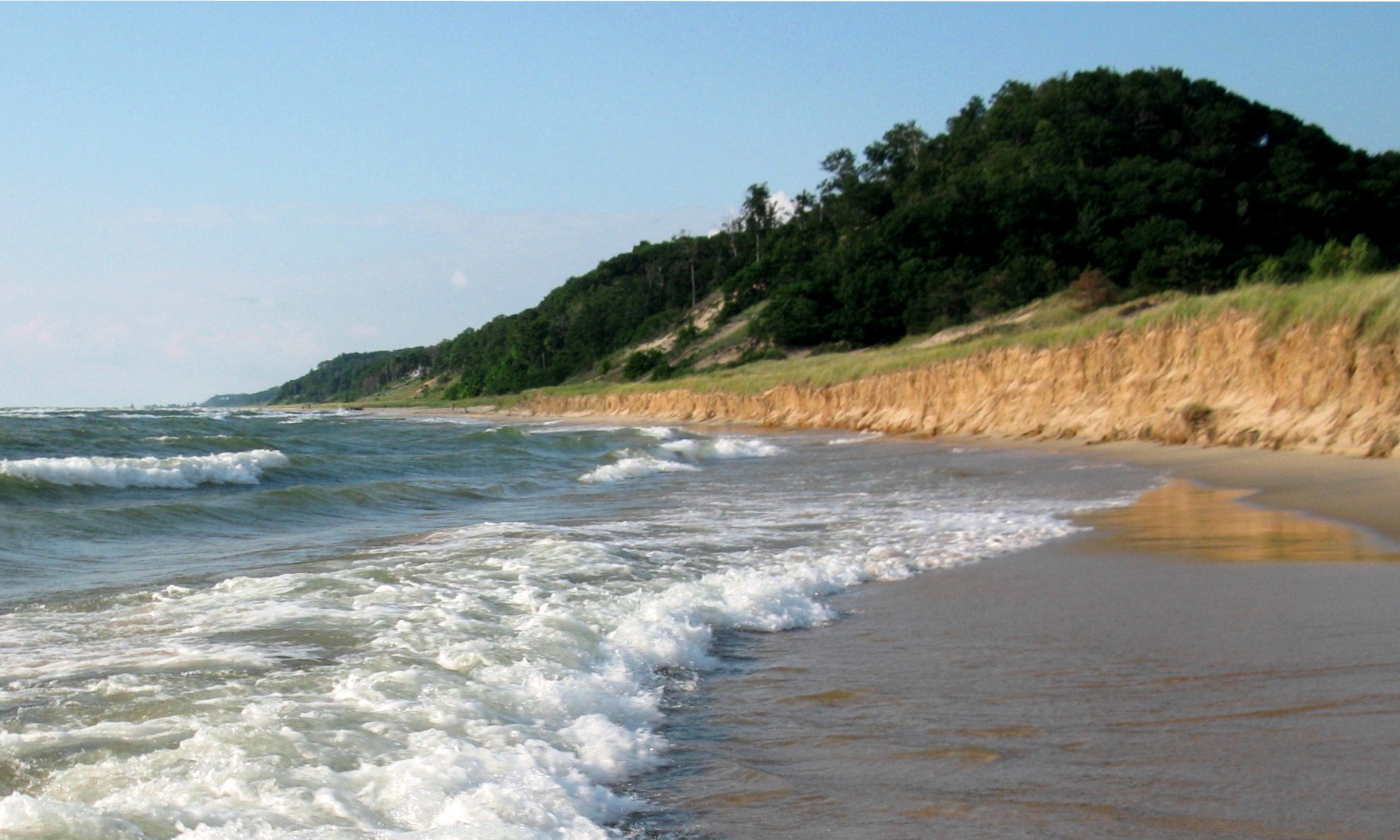
Oval Beach has been named to Condé Nast Traveler's list of the top twenty-five beaches in the world, which is the sort of accolade that invites skepticism until a visitor actually sees the place. Broad, clean sand backed by wooded dunes, with the water clarity that West Michigan delivers on a calm day, it earns the attention. It is reachable by road or on foot from the top of Mount Baldhead, and the walking approach is much the better arrival.
Popularity is the obvious cost. Parking fills on hot summer weekends, and arriving after mid-morning in July means either a long walk or a wait. The compensations are real facilities and lifeguards in season, which distinguishes it from the many beautiful but unserviced beaches along this coast. Families in particular should weigh that trade against the quieter alternatives a few miles north.
Saugatuck Dunes State Park
For visitors who want shoreline without the crowd, Saugatuck Dunes State Park protects roughly two and a half miles of Lake Michigan beach across about a thousand acres in Allegan County, along with the dune and forest system behind it. Reaching the water requires a walk — there is no driving to the sand. Four trails cross the rolling dune terrain, and the shortest route is the three-quarter-mile Beach Trail marked in yellow. That modest barrier is the park's defining feature and its principal appeal: the beach stays dramatically quieter than Oval Beach on the same afternoon.
The park is popular with birders and hikers as well as beachgoers, and its roughly thirteen miles of trails through the dunes and woods offer genuine hiking rather than a stroll to the sand. Within the park, the 300-acre Patty Birkholz Natural Area protects a coastal dune system that shelters three endangered plant species. The dune landscape here is the same system that produced the coast's more famous formations further north, and walking it gives a sense of how the whole shoreline is built. Visitors should carry water and wear real shoes; soft sand on an inclined trail is more work than the distance suggests.
The Dune Rides and the Galleries
The Saugatuck Dune Rides have been running since 1954, carrying visitors across the windswept sand in open-air buggies while drivers narrate a mix of history, geology, and practiced humor. It is unabashedly a tourist attraction and an extremely good one — the kind of thing that has survived seven decades because it delivers. For families with children, it is reliably the highlight of a Saugatuck visit.
The art that gives the coast its name is concentrated in the two downtowns. Galleries, working studios, exhibitions, and public installations run through Saugatuck and Douglas at a density that supports a full day of browsing, and Butler Street in downtown Saugatuck is the main commercial spine — shops, restaurants, and galleries in a walkable few blocks. The arts scene here is long-established rather than recently manufactured, which shows in the quality and in the number of artists who actually live and work locally.
Season and Logistics
This is a summer destination that has learned to stretch. July and August bring full operation and full crowds, with lodging booked well ahead and beach parking at a premium. September and early October are the local secret: the lake holds its warmth, the galleries stay open, the dune rides continue into the autumn, and the towns become navigable again. Winter quiets things substantially, though the arts community keeps a reduced calendar and the dunes under snow are worth seeing.
The practical advice is to base in either town and move on foot and by ferry rather than repeatedly repositioning a car. Saugatuck and Douglas are close enough to treat as a single destination, the chain ferry connects the key crossing, and the walking route over Mount Baldhead to Oval Beach turns what would be a drive into the best part of the day. Visitors who plan around parking rather than fighting it have a considerably better time here.