In This Guide
Getting There and Getting Around The Ride Around M-185 Fort Mackinac and Fort Holmes Arch Rock and the Island Interior The Grand Hotel and the Village Planning a VisitMackinac Island banned automobiles in the 1890s and never lifted the ban, which makes it the rarest thing in American travel: a place where the default assumption of car access simply does not apply. Transportation is by bicycle, on foot, or behind a horse, and the resulting quiet is the first thing every visitor notices stepping off the ferry. The island sits in the Straits of Mackinac between Michigan's two peninsulas, about twenty-five minutes by boat from Mackinaw City, and it packs a fort with fourteen original buildings, an 1877 hotel with a 660-foot porch, a limestone arch above Lake Huron, and an 8.2-mile shoreline highway closed to motor vehicles into roughly four square miles.
Getting There and Getting Around
Ferries run from both Mackinaw City on the Lower Peninsula and St. Ignace on the Upper, with the Mackinaw City crossing taking about twenty-five minutes. Vehicles stay on the mainland — visitors park at the docks and carry on what they can manage, which is the first practical adjustment the island demands. Packing light is not a suggestion here, and travelers staying overnight should understand that luggage moves by horse-drawn dray rather than by car.
Once ashore, bicycles are the default. Several shops rent singles, tandems, and tagalongs for children, and the island reportedly has more bicycles per capita than anywhere else in the world — a claim that is difficult to verify and easy to believe once the main street comes into view. Horse-drawn carriage tours are the other signature mode, and they cover the interior sights with narration that saves first-time visitors a great deal of guesswork. Walking works too; the village itself is compact.
The Ride Around M-185
The single best thing to do on Mackinac Island costs the price of a bike rental. M-185 circles the island along the shoreline for 8.2 miles and is the only state highway in the country that prohibits motor vehicles — a genuine curiosity of American road classification and, more to the point, a flat, paved, entirely traffic-free loop with Lake Huron on one side the whole way. At a leisurely pace it takes about an hour, and there is no elevation to speak of, which puts it within reach of essentially anyone who can ride a bicycle.
The loop is also the most efficient way to understand the island's geography, passing Arch Rock, the shoreline bluffs, and long stretches of undeveloped coast that most day visitors never see because they stay in the village. Riders should go early or late in the day during peak season — the road is car-free but not crowd-free, and midday summer traffic on two wheels can be surprisingly dense near town. The far side of the island stays quiet at almost any hour.
Fort Mackinac and Fort Holmes
Fort Mackinac sits on the bluff above the harbor and preserves fourteen original buildings, making it one of the more complete surviving military posts of its era in the country. Daily reenactments, interactive displays, and costumed interpretation fill the summer schedule, and the rifle and cannon firings draw crowds on the parade ground. The position explains itself the moment a visitor reaches the ramparts — the fort commands the harbor and the straits beyond, which is precisely why it was built where it was and why control of it mattered in both the Revolution's aftermath and the War of 1812.
Higher on the island, Fort Holmes occupies the highest point and can also be toured. It is a smaller and simpler site than Fort Mackinac, and correspondingly less visited, which is much of its appeal — a walk or ride up to it delivers the island's best elevated view along with a fort that visitors frequently have largely to themselves. Together the two forts make the military history legible in a way that a single site would not.
Arch Rock and the Island Interior
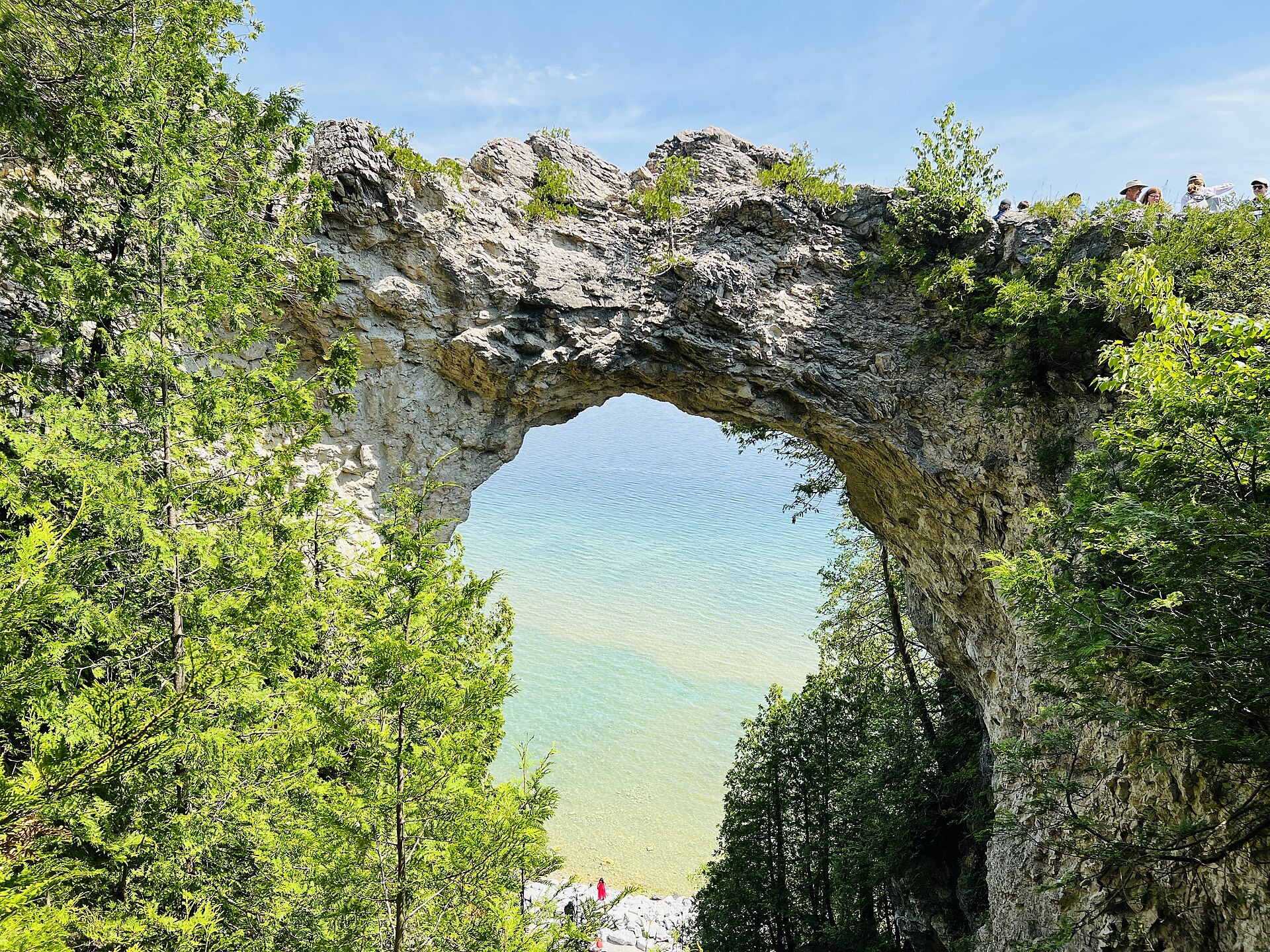
Arch Rock is a natural limestone arch on the island's eastern coast, standing high above Lake Huron with the water framed through the opening — the island's most photographed natural feature and a genuinely striking one. It can be reached from the shoreline road below by a substantial stairway or approached from above on the interior trails, and doing both gives the better sense of its scale.
The interior deserves more attention than it gets. A large share of the island is protected parkland threaded with hiking and nature trails leading past limestone bluffs, caves, and forest, and the contrast with the fudge shops and carriage traffic of the village is total. Visitors who spend an afternoon inland will find that most of the island's area is quiet even on a busy August day. This is where the island rewards a multi-day stay over a day trip.
The Grand Hotel and the Village
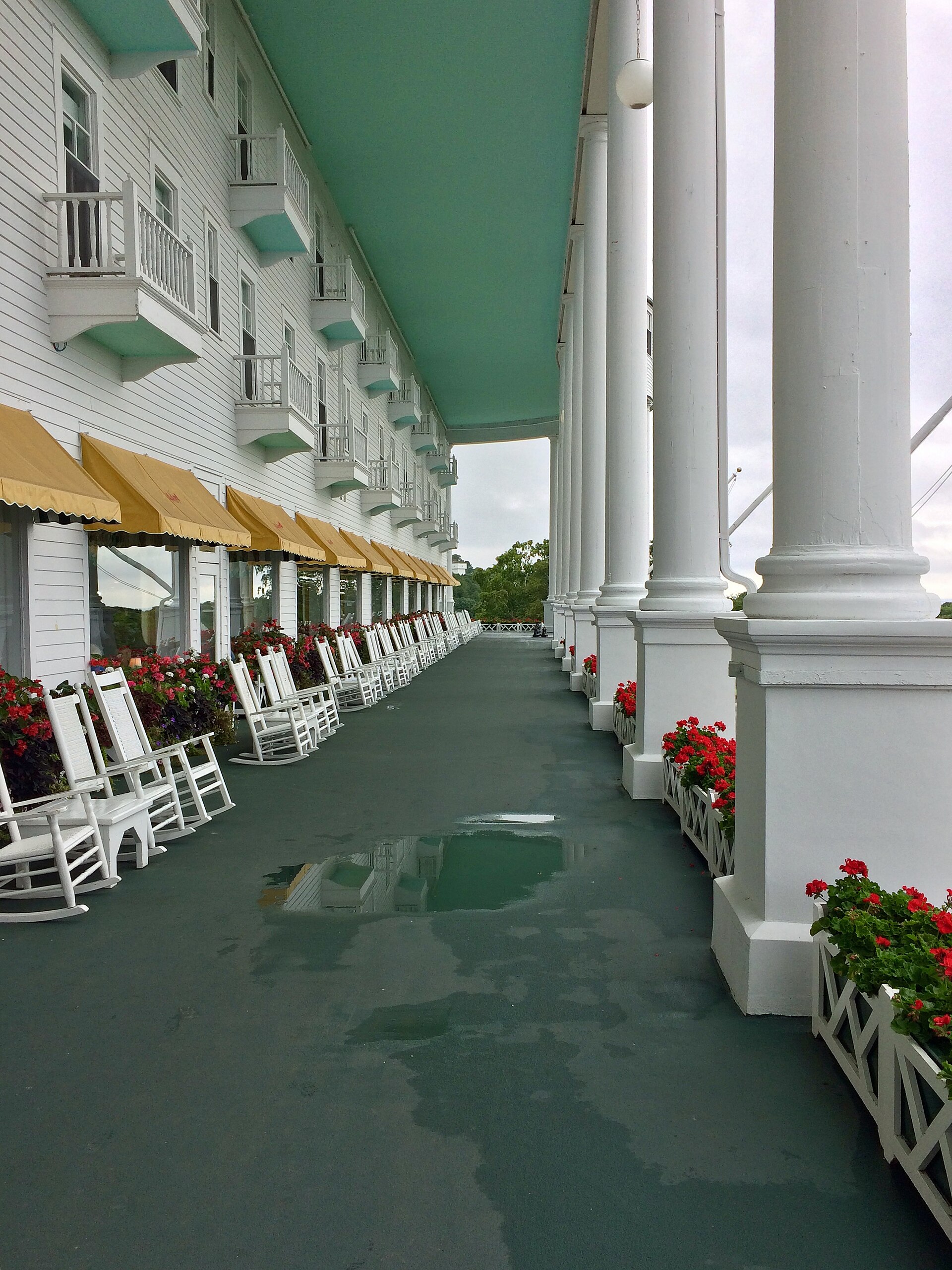
The Grand Hotel opened in 1877 and remains the island's defining building, fronted by a porch of 660 feet that it advertises as the world's longest. Non-guests are charged an admission fee to walk the grounds and porch during the day, which surprises some visitors, but the building is worth seeing regardless of whether one is staying. Its scale and its era are both entirely intact, and it anchors the island's identity as a nineteenth-century resort that never modernized.
Down in the village, fudge is the other institution. Dozens of shops make it on marble slabs in front windows, and the smell along Main Street is inescapable — Michiganders have long called summer visitors "fudgies" for good reason. Between the fudge shops, galleries, and outfitters, the village handles a very high volume of day visitors, which is exactly why the shoreline loop and the interior trails matter so much to the quality of a visit.
Planning a Visit
Season governs everything. Summer is peak in every sense — full ferry schedules, everything open, and crowds that concentrate heavily in the village between mid-morning and late afternoon when the day-trip boats arrive and depart. Visitors staying overnight get the island in its best condition: early mornings and evenings after the day crowd leaves are a completely different and far quieter place, which is the strongest argument for booking a room rather than doing this as a day trip.
Autumn brings color and thinner crowds with most services still running, and it is arguably the ideal time to come. Winter reduces the island to a few hundred year-round residents, with ferry service curtailed and most businesses closed — a genuinely remarkable time to see it, but one requiring real planning. Whatever the season, book lodging well ahead, pack light, and remember that once the ferry leaves, there is no running back to the car for something forgotten.