In This Guide
The World's Largest Musical Fountain A Pier Built for the Evening Walk A Festival Born of LossGrand Haven occupies the spot where the Grand River, the longest river entirely within Michigan, finally empties into Lake Michigan after a journey of more than 250 miles across the width of the state, and that river-mouth geography has given the town both a genuinely excellent natural harbor and one of the more distinctive boardwalk experiences on the entire west coast. Generations of families have made the mile-and-a-half boardwalk connecting downtown to the beach into a nightly summer ritual, one that reliably ends with a crowd gathered along the waterfront for a nightly spectacle that has become, somewhat improbably, one of the largest of its kind anywhere in the world.
The World's Largest Musical Fountain
The Grand Haven Musical Fountain, first built in the 1960s and rebuilt with modern computerized controls since, sends water jets synchronized to recorded music arcing more than one hundred feet into the air over the Grand River, the whole display illuminated after dark by colored lights choreographed to match the score, and organizers have long billed it as the largest musical fountain of its kind in the world. Watching the show for the first time tends to catch visitors off guard, since a modest lakeside town of roughly eleven thousand year-round residents does not obviously announce itself as the home of an attraction on this scale, and the nightly crowds that gather along both banks of the river each summer evening suggest the fountain has more than earned its outsized local reputation.
The show runs on a rotating repertoire that ranges from patriotic standards to Broadway numbers to contemporary pop, and the display's choreography, timed precisely to each piece's musical peaks and quiet passages, has been refined across six decades of near-continuous summer operation.
A Pier Built for the Evening Walk
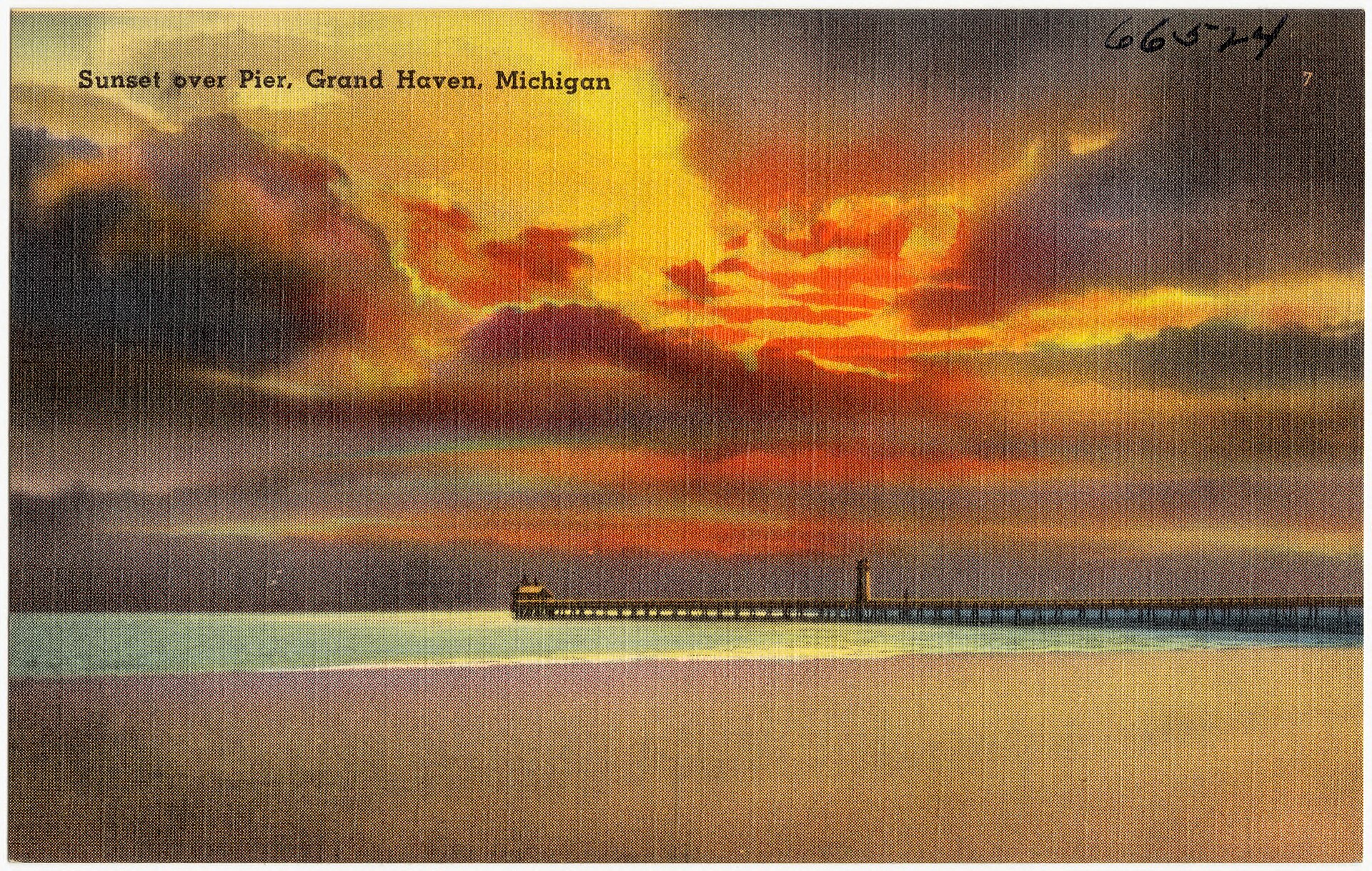
Grand Haven's south pier, capped by a red catwalk-connected lighthouse pair, extends far enough into Lake Michigan that walking its full length at sunset has become one of the defining rituals of a Grand Haven summer evening, the elevated catwalk allowing pedestrians to cross safely even when waves are breaking directly over the pier's lower sections during rougher weather. The lighthouse itself, an inner light and an outer light connected by that raised walkway, has guided boats into the river mouth since the 1890s, and its unmistakable red silhouette against a Lake Michigan sunset has become one of the most reproduced images associated with Michigan's entire west coast tourism identity.
The boardwalk connecting the pier to downtown and the municipal beach beyond gives visitors a genuinely walkable route that takes in the marina, the fountain, the pier, and a proper sand beach without requiring a car at any point, a rare convenience among Michigan's Lake Michigan resort towns.
A Festival Born of Loss
Grand Haven's identity as a Coast Guard town runs deeper than pageantry: the Coast Guard cutter Escanaba was commissioned in Grand Haven in 1932 and stationed there for its first eight years, becoming enough of a local fixture that its eventual fate hit the town hard. While escorting a troop transport across the North Atlantic during the Second World War, the Escanaba was struck by a German submarine and sank in June 1943, and citizens of Grand Haven and the surrounding area responded by raising a million dollars in war bonds within three months specifically to fund a replacement cutter carrying the same name, an extraordinary act of collective civic grief and resolve for a town of its size.
The Coast Guard Festival that Grand Haven now hosts each summer traces its roots to informal district picnics dating back to 1924, but it took on its deeper meaning after the original Escanaba's loss, and the festival today combines a genuinely festive week of parades, concerts, and a Coast Guard cutter open for public tours with an undercurrent of real memorial weight that distinguishes it from a purely recreational summer event. A third cutter bearing the Escanaba name, commissioned in Grand Haven in 1987 under the motto 'The Spirit Lives On,' still returns to visit the town periodically, closing a loop between the community and the vessel's namesake that has now stretched across nine decades.