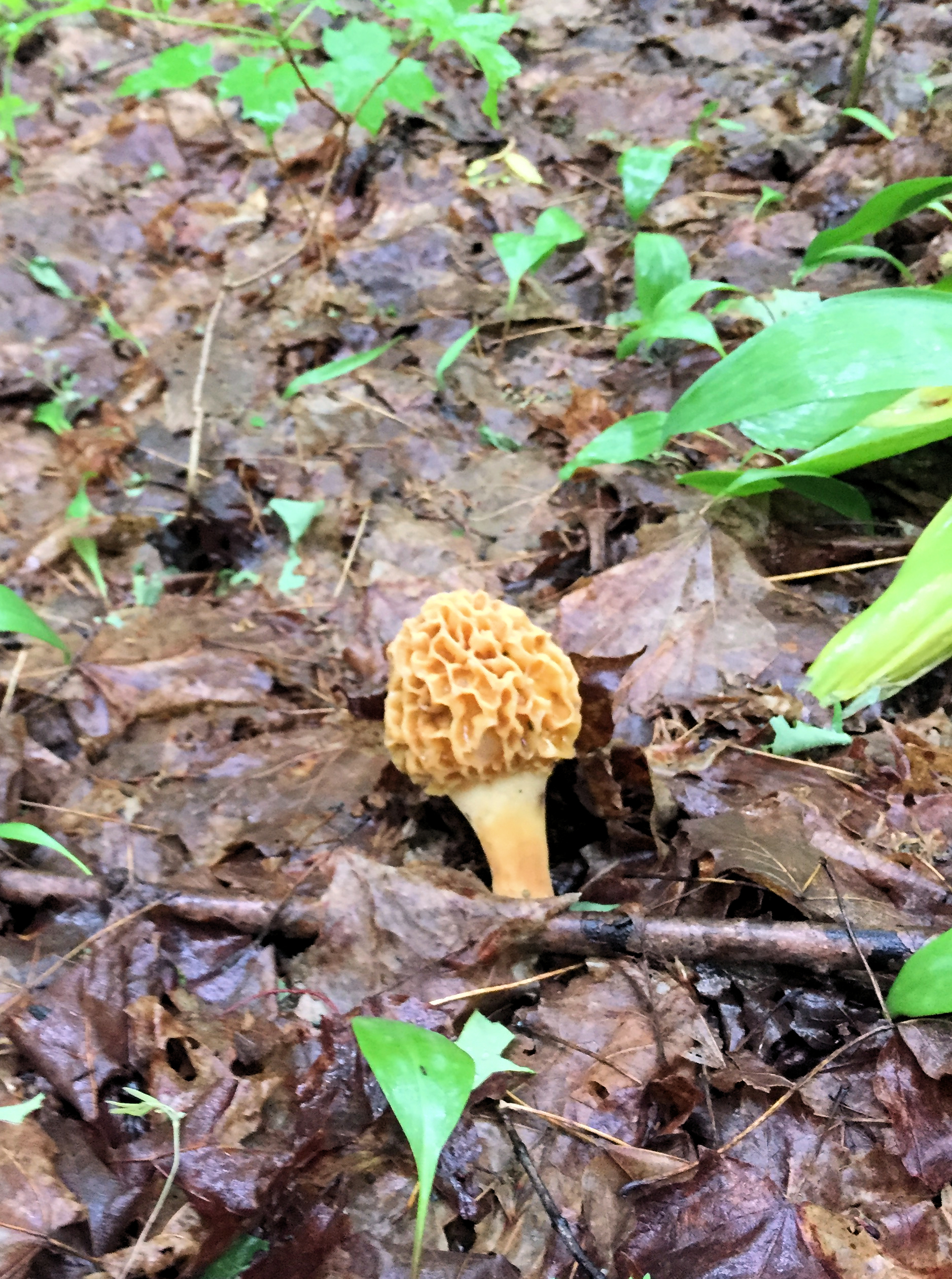

A morel can disappear into fallen leaves even when you know where to look. Its ridges echo the bark around it; its color settles into the browns of the forest floor. A step closer can turn an uncertain shape into something unmistakable. Teaching a camera to make that discovery is harder still. Distance, shade, branches and motion blur can reduce a mushroom to a handful of pixels.
Mushroom Vision is Great Lakes Gleaner’s invitation to help solve that problem. We are building vision software that learns from real mushroom photographs and video, beginning with a strong focus on morels. The aim is to improve detection in difficult conditions and, over time, support more useful identification. That work begins with people looking carefully at what an image actually shows. You can join it now in the Mushroom Vision fieldwork lab.
A few minutes. A careful look.
Open the lab and examine a woodland frame. If mushrooms are visible, draw a tight box around each one you can distinguish. If none are visible, say so; if the image is too blurry or ambiguous, choose “I’m not sure.” You do not need to provide a species name to make a useful contribution. An honest uncertainty is more valuable than a confident guess that becomes a bad training example.
Start with your own observation before opening the optional AI suggestions. Correct the boxes, add anything the software missed, and mark the frame complete only after checking the whole image. Nearby frames stay connected to the same video, so you can look back and ahead for context. A mushroom becoming obvious in a later frame does not automatically make it visible in an earlier one. Those differences help us study how recognition changes as a subject gets smaller, farther away or harder to separate from its surroundings.

How an observation becomes better software
Community submissions enter a curator review queue. Complete, approved examples can then help train a candidate model, which is compared with the existing detector on separate footage. A person reviews the results before a new model is selected. The lab also needs clear negative examples: leaves, bark, shadows and other shapes that resemble mushrooms. Finding more mushrooms matters, but so does avoiding a flood of false sightings.
Today’s detector produces unverified mushroom candidates. Reliable species identification and real-world detection distances have not yet been established, and the current training loop is focused on locating mushrooms. Submitting a review accepts the lab’s displayed terms for using your annotations in training, evaluation and software improvement, including commercial applications. Source images retain their own licenses, and earlier permission choices remain respected. The lab explains how to withdraw an annotation’s permission for future use.
Built for an open-source future
We will release Mushroom Vision as open-source software once it is trained, tested and ready. The release will explain how it was trained, how it was evaluated and where it still falls short. Our aim is for others to inspect the work, reproduce results and improve it for their own applications. Trained models and reusable data will be shared where their licenses and permissions allow, with attribution preserved. Contributing here helps build the evidence that makes that future release useful.
A wider view of the fungal world
Better vision could help naturalists and researchers build a richer catalog of mushrooms and other fungi, especially forms that are difficult to pin down. Spotting a mushroom, placing it in a broad group and establishing its species are different tasks. Some morel species can be difficult to distinguish by appearance alone, and genetic evidence can help resolve those uncertainties, as research on morel identification demonstrates. A useful system should keep photographs connected to field observations, expert determinations and, where available, preserved specimens or sequence records. It should also keep uncertainty visible instead of forcing a species name onto every image.
There is a practical model for that kind of recordkeeping. The North American Mycological Association’s voucher program connects photographs and expert identification with preserved specimens for future examination. Mushroom Vision’s longer-term goal is to help people find, organize and revisit evidence that can support such work. Possible applications include field surveys, educational tools and camera-assisted observation. The software would support the people doing the research; a proposed match alone would not establish a species or a new scientific discovery.
A possible tool for medical professionals
Another goal is to help medical professionals and mushroom specialists better identify mushrooms involved in accidental ingestion. A future, separately evaluated version could help organize photographs, surface possible matches and bring relevant visual evidence into expert review. Poison centers already work with mycologists on identification, as the Utah Poison Control Center explains. That is a potential application, not a clinically validated capability of the current lab. Mushroom Vision is presently a research tool and cannot determine whether a mushroom is safe to eat or direct treatment.
If someone may have eaten a poisonous mushroom, contact U.S. Poison Control at 1-800-222-1222 promptly. Do not wait for an identification from Mushroom Vision.
Help Mushroom Vision learn.
Look closely. Mark what is visible. Leave uncertain details uncertain. A few thoughtful reviews can contribute to a better foundation for everyone who wants to understand fungi.
Open Mushroom Vision fieldwork